
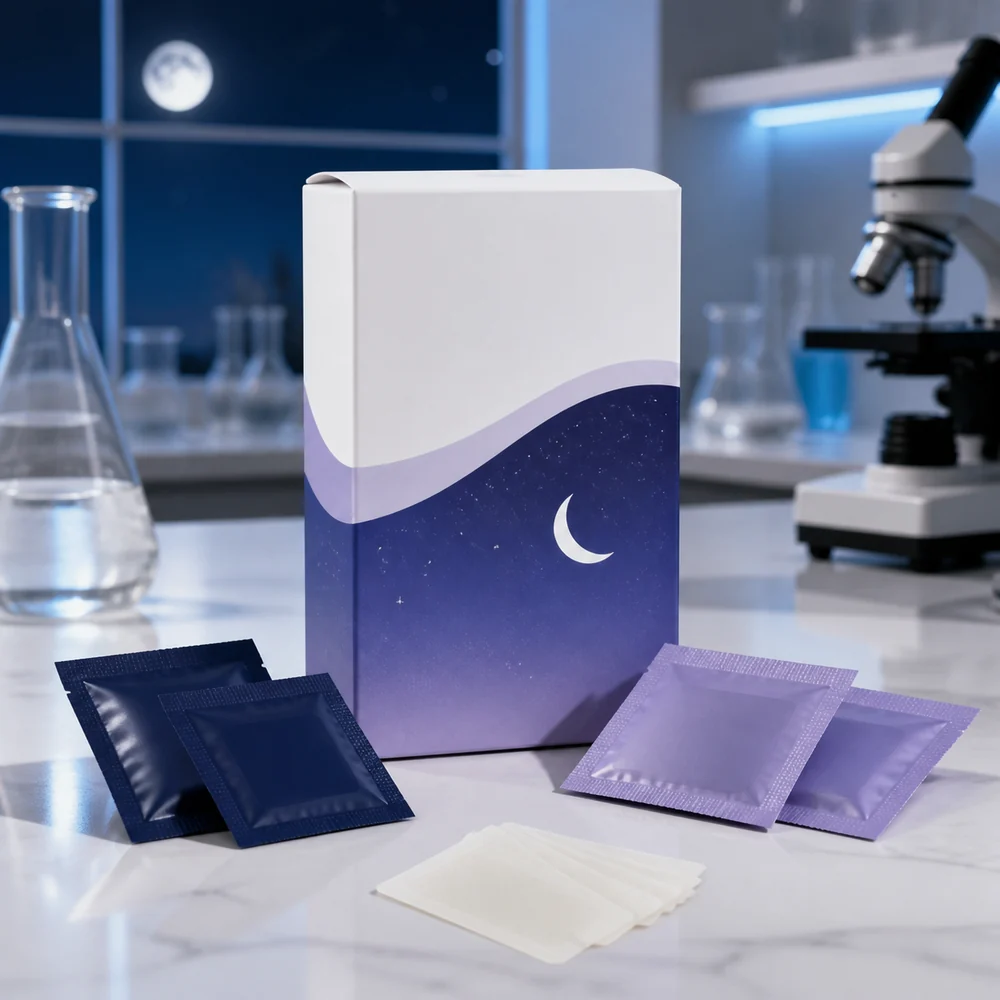
Melatonin Orodispersible Film (Melatonin ODF) is a thin oral film format supplied in individual protective sachets. It may be considered for sleep-support product concepts only where the ingredient, dosage form and proposed claims are permitted by the destination market.
Linkbiolabs provides B2B development and manufacturing support for private label Melatonin ODF, covering formula feasibility, film casting, pilot sampling, sachet packaging, specifications and commercial scale-up.
| Project variable | Development consideration |
|---|---|
| Melatonin target | Must be assessed against local classification and dose rules |
| Film size | Balanced with active distribution, handling and disintegration |
| Flavor profile | Mild mint, berry, citrus or other feasible nighttime-positioned concepts |
| Sweetener system | Selected for taste, film compatibility and local compliance |
| Sachet design | High-barrier individual pack with clear directions and lot coding |
| Retail pack | Custom count, carton, dispenser and wholesale case configuration |
Melatonin is regulated differently around the world. Depending on country, dose and presentation, a product may fall under food supplement, natural health product, therapeutic good, medicine or another category. Some markets restrict over-the-counter supply or require authorization. For that reason, the commercial brief must identify the destination country before formula approval or artwork development.
Low-dose ingredients require a validated approach to dispersion and unit uniformity. The manufacturer must control mixing, coating, drying and slitting so that representative units meet the approved specification. Finished-film assay and content-uniformity testing should be based on a justified sampling plan.
Film flexibility and disintegration can change when the product gains or loses moisture. Packaging selection should be supported by compatibility and stability data in the final sachet. Where the formula or ingredient is light-sensitive, the laminate and carton should provide appropriate protection.
Responsible-use note: Melatonin can cause drowsiness and may not be suitable for everyone. Product warnings, age limits, interaction statements and directions must follow applicable law and professional regulatory advice. This manufacturing page does not provide medical advice.
No. Classification and permitted supply vary substantially. The destination market must be reviewed before development and sale.
Yes, within technical and regulatory feasibility. Film dimensions, flavor, appearance, pack count and printed packaging can be developed for the project.
Typical controls include identity, assay, content uniformity, film weight and thickness, disintegration, moisture, microbiology and packaging integrity.
Yes. The proposed shelf life should be supported by stability data generated with the final formula and commercial packaging.