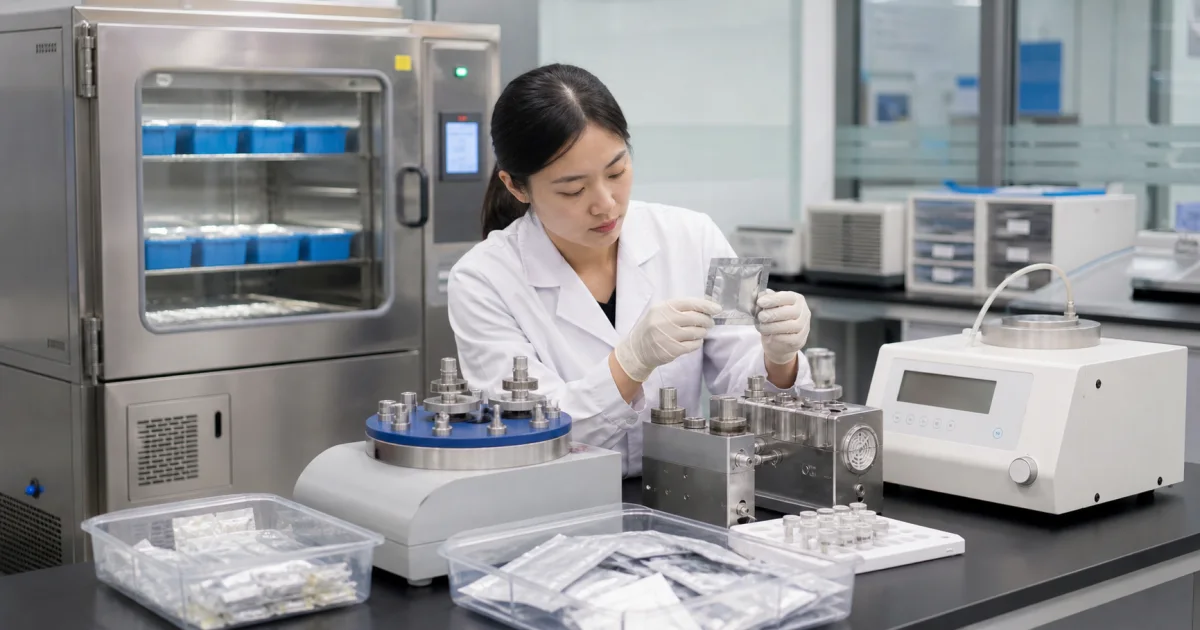
Functional oral pouches place dissolved ingredients close to the buccal mucosa, but the extent and speed of mucosal uptake depend on the molecule and finished formula. Format alone does not prove faster or greater absorption.
This 2026 guide is for private-label buyers, importers and product teams. It is educational rather than medical advice. All oral pouch concepts discussed are nicotine-free and tobacco-free.
Quick technical decision table
| Development area | Decision | Evidence |
|---|---|---|
| Formula | Ingredient fit and target amount | Specification and feasibility review |
| Process | Critical parameters and limits | Pilot records and in-process data |
| Quality | Label-to-product consistency | Assay, uniformity and stability |
| Market | Classification and claims | Destination-market review |
What controls release
Pouch fabric, moisture, particle size, solubility, pH, active load and saliva interaction influence how ingredients leave the pouch. Release into saliva is not identical to permeation across tissue or systemic bioavailability.
How evidence is built
Developers may begin with dissolution or release testing and in-vitro permeation models, then use appropriately designed human studies where a commercial claim requires them. Results from one active or prototype should not be generalized to every pouch.
Responsible communication
Describe placement, water-free use and measured product characteristics. Avoid claiming superior bioavailability, instant action or a fixed onset unless validated for the marketed formula and permitted by local rules.
OEM buyer checklist
- Confirm ingredient permission and product classification in each target market.
- Approve measurable formula, process and finished-product specifications.
- Review raw-material identity, purity, allergens and contaminant controls.
- Validate unit uniformity, microbiology, packaging and shelf life.
- Complete claims and artwork review before commercial printing.
Frequently Asked Questions
Can one specification be used in every country?
No. Ingredient, dose, label, warning and claim rules differ by market.
What makes an OEM sample ready for scale-up?
The sample must match an approved written specification and pass relevant analytical, sensory and packaging checks.
Should brands promise faster absorption?
Only when product-specific evidence supports the exact claim and local rules permit it.
Where can buyers learn more?
Review the 2026 sourcing guide, the ODF manufacturing guide, Caffeine ODF and OEM consultation.
Compliance note: Regulations can change. Verify current requirements before manufacture, import or sale.