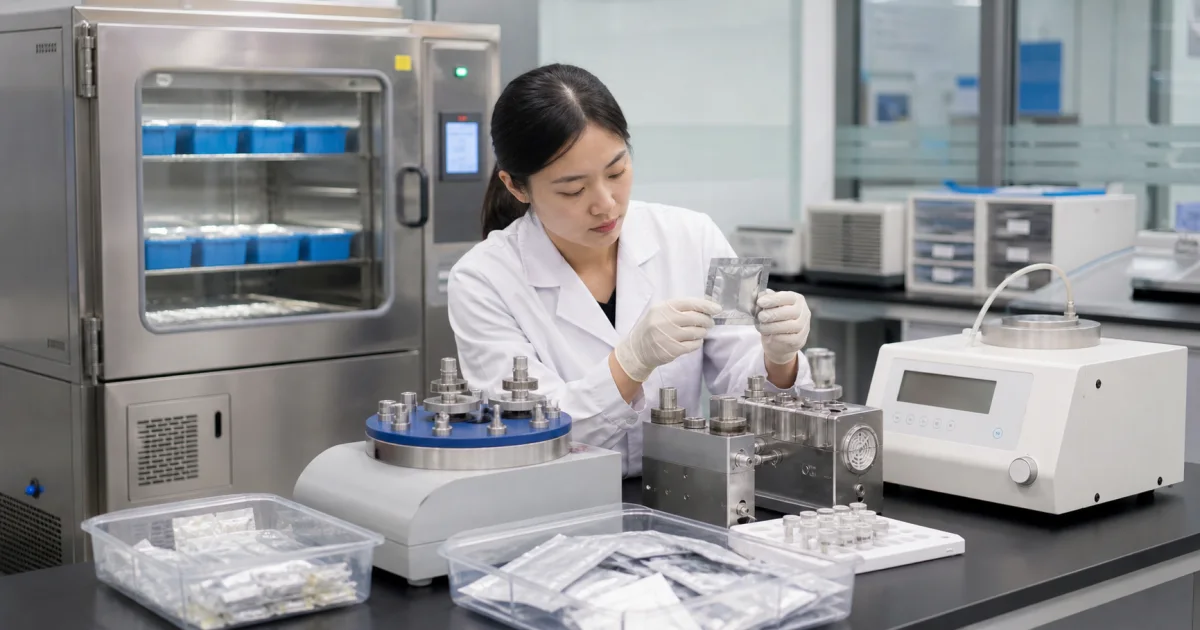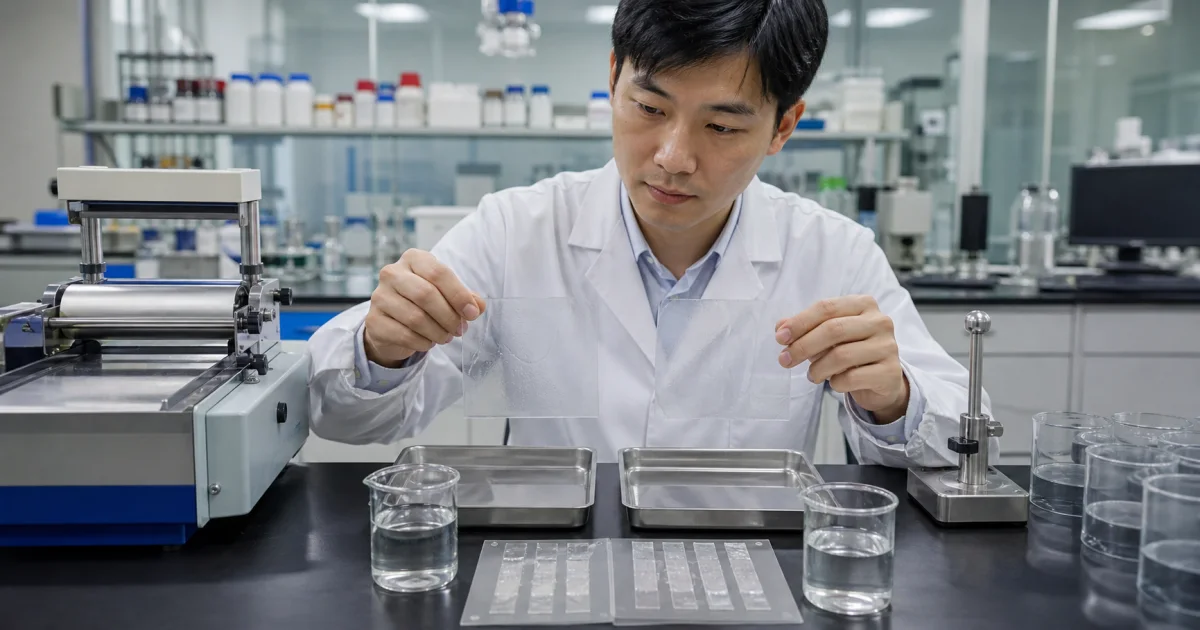
HPMC vs pullulan ODF selection affects solution viscosity, casting behavior, mechanical strength, moisture response, taste and disintegration. Neither polymer is universally superior. The most suitable system depends on active loading, strip size, flavor, plasticizer, drying capacity, packaging barrier and the finished-product target.
How the two polymer families differ
Hydroxypropyl methylcellulose, commonly abbreviated HPMC, is available in multiple substitution and viscosity grades and is widely used as a film former. Pullulan is a polysaccharide known for forming clear films with useful oxygen-barrier characteristics under controlled humidity. Commercial ODF systems may use one polymer or a blend with other film-forming and structure-modifying ingredients.
Comparisons must name the exact grades. A generic HPMC-versus-pullulan conclusion can be misleading when molecular weight, viscosity and formulation ratios differ.
Development comparison
| Factor | HPMC system | Pullulan system |
|---|---|---|
| Grade flexibility | Broad viscosity-grade options | Performance depends on selected grade and blend |
| Solution processing | Hydration sequence and lump control matter | Dissolution and batch viscosity require control |
| Film appearance | Can produce clear or translucent films | Often selected for clear film concepts |
| Mechanical balance | Adjusted through grade and plasticizer | May need formulation support for the target flexibility |
| Moisture response | Product-specific and grade-dependent | Humidity can strongly influence properties |
| Scale-up decision | Depends on viscosity and drying window | Depends on viscosity, cost and supply consistency |
Control solution viscosity and entrapped air
Polymer addition sequence, water temperature, mixing energy and hydration time influence viscosity and uniformity. Undispersed polymer can create gel particles or streaks. Excessive mixing may entrain air, leading to bubbles or pinholes in the cast film.
Viscosity should be measured at a defined temperature, spindle, speed and rest time. A single value without method conditions cannot guide scale-up. The commercial mixer may produce different shear and deaeration than a laboratory beaker.
Balance strength with fast disintegration
A film must survive peeling, winding, slitting and sachet packing while still dispersing according to the product target. More polymer or less water-soluble structure can improve handling but slow disintegration. More plasticizer may improve flexibility while increasing tack, blocking or moisture sensitivity.
Measure tensile strength, elongation, folding endurance and disintegration on conditioned samples. Test units from the edge and center of the web because thickness and drying can vary across the coater.
Evaluate active and flavor compatibility
Caffeine, melatonin, acids, salts, flavors and sweeteners can change polymer hydration and film structure. An ingredient may crystallize during drying or migrate during storage. Visual clarity is not proof of content uniformity; assay and unit-level sampling remain necessary.
Taste and mouthfeel can also differ. The polymer system influences how quickly flavor and active are released, while residual moisture affects stickiness and perceived texture.
Package for the moisture sensitivity observed
Both formulations should be evaluated at realistic temperature and humidity. A film that performs in a dry laboratory may curl, soften or stick during distribution. Individual high-barrier sachets are often considered, but the required construction should be selected through stability data rather than convention.
ODF buyer checklist
- Identify exact polymer grades and approved suppliers.
- Define viscosity test conditions and the commercial mixing sequence.
- Compare casting defects, drying time and film release from the liner.
- Measure strength, elongation and disintegration after conditioning.
- Check active crystallization and content uniformity.
- Study moisture response in the intended sachet.
- Lock polymer and plasticizer changes through formal change control.
Frequently asked questions
Does pullulan always dissolve faster than HPMC?
No. Grade, thickness, plasticizer, active loading and test method can change disintegration behavior.
Can HPMC and pullulan be blended?
Potentially, but compatibility, viscosity, mechanical properties and stability must be demonstrated for the specific ratio.
Which polymer is best for caffeine ODF?
The choice depends on caffeine loading, taste masking, strip size, drying and packaging targets; prototype data should drive the decision.
Related resources: private-label ODF manufacturing, ODF casting defects, ODF disintegration testing and caffeine ODF taste masking.