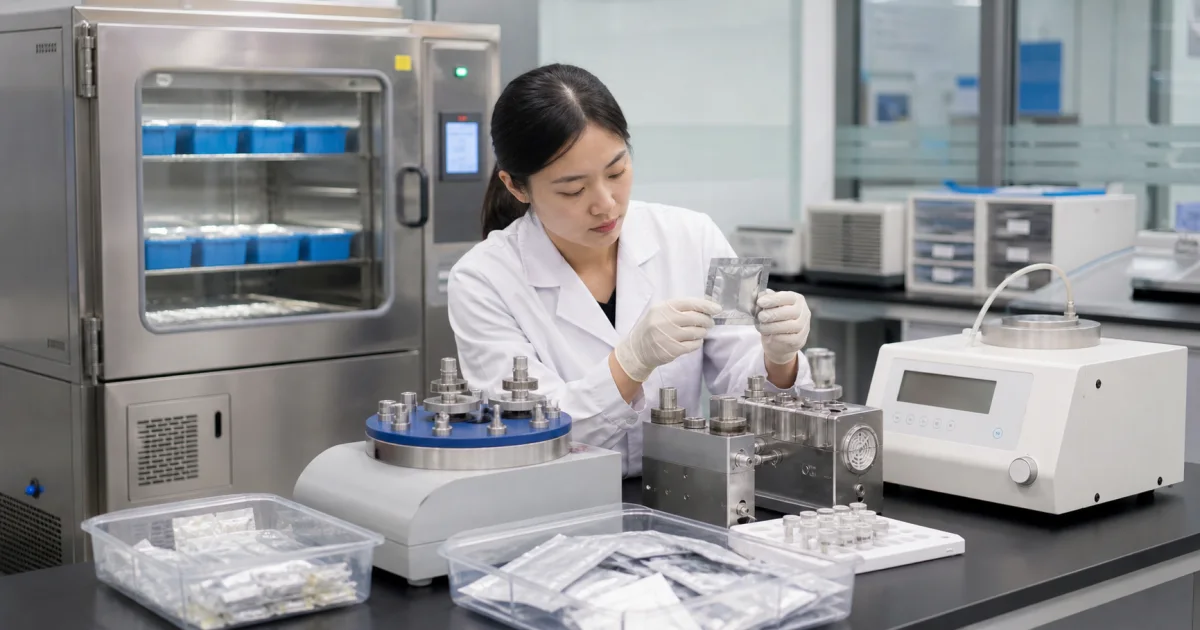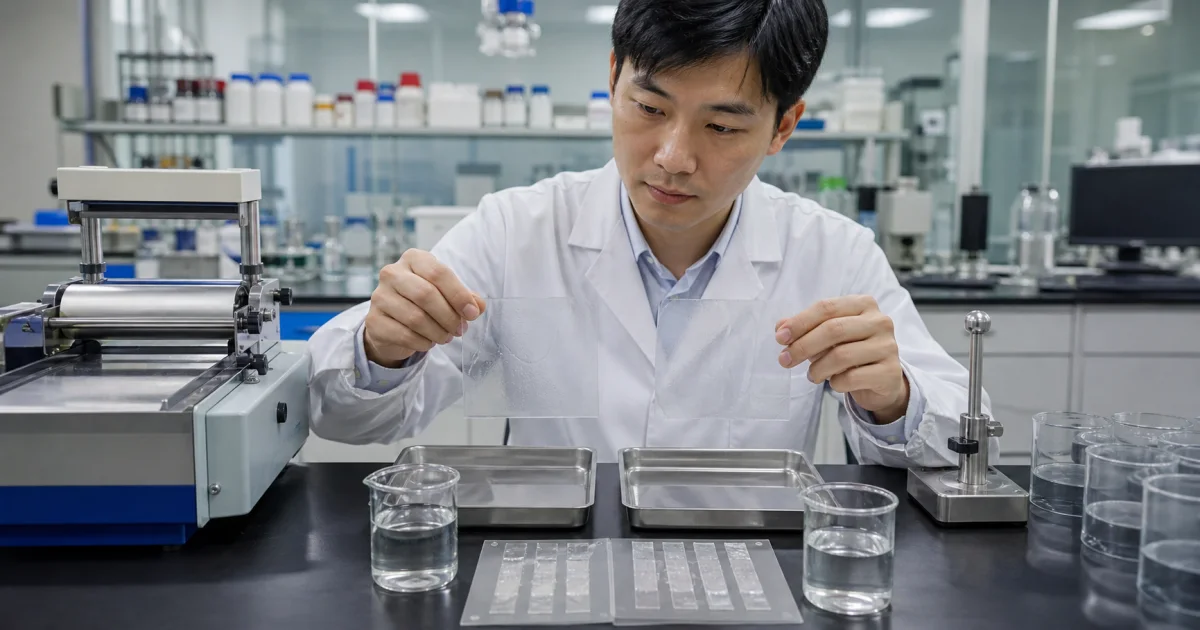
ODF film casting defects such as pinholes, bubbles, curling and brittleness usually come from interactions among dispersion quality, coating conditions, drying and film composition. Correcting only the visible symptom often moves the problem elsewhere—for example, adding more plasticizer may reduce cracking but increase tack and sachet sticking. OEM troubleshooting should connect each defect to measurable raw-material and process data.
Quick ODF defect troubleshooting table
| Defect | Common contributors | First checks |
|---|---|---|
| Pinholes | Entrained air, particles, poor wetting or contamination | Deaeration, filtration, surface cleanliness |
| Bubbles | Mixing shear, foam stability or rapid drying | Mix speed, hold time and dryer profile |
| Curling | Moisture gradient or asymmetric shrinkage | Top/bottom drying balance and residual moisture |
| Brittleness | Low plasticizer, overdrying or polymer mismatch | Mechanical properties and moisture |
| Tackiness | High residual moisture or plasticizer migration | Water activity, conditioning and packaging |
| Thickness variation | Viscosity drift, coating-gap or web-speed variation | In-process thickness map |
Pinholes begin before the coating head
Undissolved polymer, botanical particles and air bubbles can interrupt a thin wet film. The dispersion should have a defined mixing sequence, hydration time, temperature and filtration step. High shear may improve dispersion but also entrain air. A controlled deaeration period or validated vacuum step can reduce bubbles without allowing solids to settle.
Surface cleanliness matters at thin film thicknesses. Small particles on the liner or coating surface can create repeating defects. Operators should distinguish random formulation defects from defects that repeat at the same web position.
Control viscosity over the full coating run
Viscosity affects leveling and the relationship between coating gap, web speed and final dry thickness. Temperature, evaporation and continued polymer hydration can change viscosity during a long run. Measuring only the starting batch is not enough. Record viscosity and temperature at defined intervals and compare them with the thickness map.
If insoluble ingredients are present, sedimentation control and gentle recirculation may be necessary. The process must avoid both settling and excessive aeration.
Why ODF films curl
Curling often indicates uneven stress or moisture across the film thickness. One surface may dry faster than the other, especially when air velocity and temperature are aggressive. Liner interaction can also influence shrinkage and release behavior. The team should inspect curl direction, time of appearance and response to humidity conditioning.
Changing dryer temperature alone may not solve the issue. Polymer ratio, solids content, plasticizer distribution, wet thickness and residence time should be reviewed as a system.
Brittleness versus tack: finding the operating window
Low residual moisture and insufficient plasticization can reduce elongation and cause cracking during slitting or sachet packing. Excess moisture or plasticizer may create blocking, sticking and poor cut edges. Mechanical testing should include tensile strength, elongation, folding endurance and handling observations at the intended storage condition.
The target is a stable operating window, not the softest possible fresh film. Pilot rolls should be conditioned and packed before final approval.
OEM scale-up checklist
- Lock polymer grade, plasticizer and solids specifications.
- Define mixing order, hydration, filtration and deaeration.
- Monitor viscosity and temperature during coating.
- Map wet and dry thickness across and along the web.
- Document dryer-zone temperature, airflow and residence time.
- Test conditioned mechanical properties and residual moisture.
- Inspect roll edges, release liner and sachet-machine performance.
Frequently asked questions
Can visual inspection alone release an ODF batch?
No. Appearance is important, but thickness, unit mass, assay, uniformity, mechanical properties, disintegration, moisture and microbiological requirements may also apply.
Are small bubbles acceptable?
The acceptance criterion should be risk-based and written. Bubbles may affect appearance, dose uniformity, strength or sealing performance depending on their size and location.
Why does a film curl only after sachet opening?
The film may be responding to a humidity change or releasing stored drying stress. Packaging and conditioning studies help identify the cause.
Learn more in the private-label ODF manufacturing guide, film thickness control guide and ODF OEM consultation.