
Ascorbic acid and sodium ascorbate are both vitamin C sources, but they are not interchangeable by ingredient weight in a private-label oral pouch. The salt contributes sodium and has a different formula mass. It can also change flavor and local pH. A useful OEM comparison therefore fixes the intended vitamin C declaration first, then tests finished pouches for content, sensory acceptance and stability in the chosen can.
NIH’s Office of Dietary Supplements lists ascorbic acid and mineral ascorbates among supplement forms. That source does not approve a particular oral pouch, dose or mouth-contact claim.
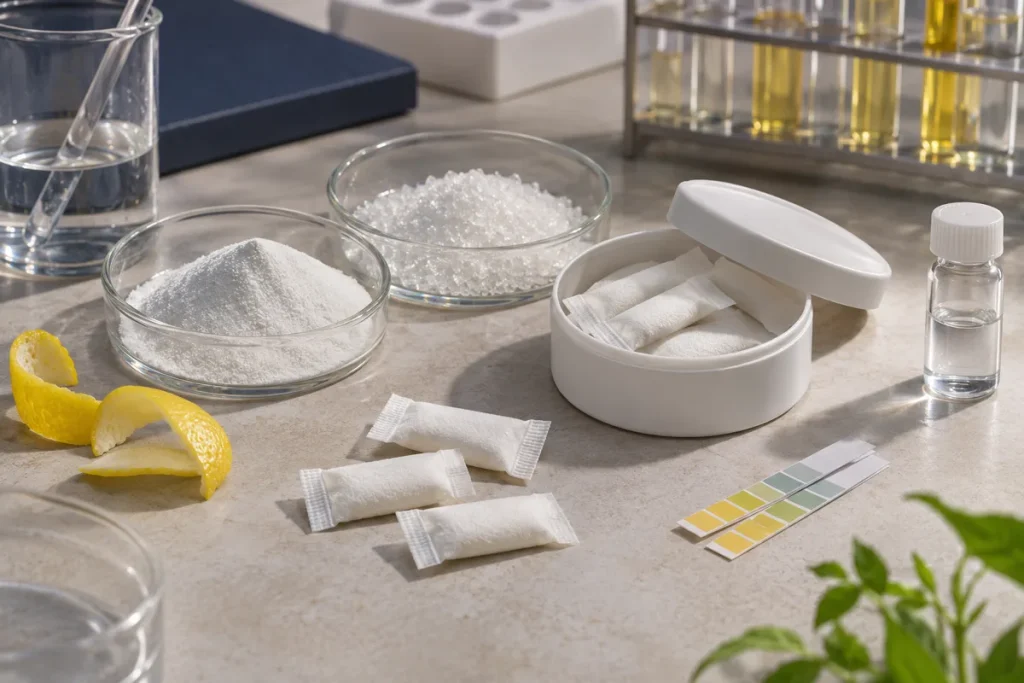
What changes when the source changes?
The formulation team must calculate the target using the vitamin C contribution of the purchased material, not assume that one milligram of each raw material gives the same labeled amount. NIH PubChem lists molecular weights of 176.12 g/mol for L-ascorbic acid and 198.11 g/mol for sodium ascorbate. On that simple molar-mass basis, pure sodium ascorbate supplies about 88.9% as much ascorbic-acid equivalent by weight. Actual formulation calculations must still use the supplier’s assayed grade. The salt also adds sodium, which may matter to flavor and declaration.
A practical two-prototype brief
- Hold the target declared vitamin C amount and pouch size constant.
- Record ingredient grade, assay basis, supplier and lot for each candidate.
- Calculate vitamin C equivalent and sodium contribution separately.
- Compare moisture, pH, flavor, mouthfeel and finished-unit assay at release and during storage.
| Decision | Ascorbic acid | Sodium ascorbate |
|---|---|---|
| Chemical form | Acid | Sodium salt |
| Formula calculation | Use assayed vitamin C contribution | Use assayed contribution and account for sodium |
| Sensory hypothesis | May give a sharper acidic profile | May change saltiness and acidity |
| Release requirement | Finished-unit test | Finished-unit test |
Does a less acidic ingredient mean a gentler pouch?
Not by itself. Bench pH is a formulation variable, while comfort depends on the complete pouch: fiber, moisture, flavor system, exposure time and individual response. A “gentle on gums” claim needs a defined outcome and product-specific evidence; the salt name cannot establish it. Run a controlled sensory screen using the final nonwoven, can and use instructions, and stop any prototype that causes persistent irritation.
See the site’s mouth-gentle pouch guide and nonwoven selection guide for material decisions. Neither source should be read as proof that a finished vitamin C pouch prevents dental problems.
Which quality tests should the OEM quote?
Ask for identity and assay on the incoming vitamin C source, then a finished-pouch method that can extract the ingredient from the full matrix. Test units across the blend and packing run, not only a pooled powder sample. During stability, follow vitamin C content alongside moisture, discoloration, flavor and can closure performance. Agree on the shelf-life acceptance limits before the study begins.
Vitamin C can be sensitive to processing and storage conditions, but the rate of loss is formula- and package-specific. The oral pouch shelf-life guide explains why the commercial can must be used. A supplier certificate is useful for raw-material control; it does not establish the amount in every retail unit.
How should claims be reviewed?
Separate nutrient content from any health claim. The EU’s Regulation 432/2012 lists authorized vitamin C claims with conditions of use, but that list does not settle whether a specific oral pouch qualifies as a food or meets the condition. In the US, FDA distinguishes health, nutrient-content and structure/function claims. Review classification, instructions, label and advertising with market counsel before printing.
A concise buyer request is: two formula prototypes, both with the same target vitamin C declaration, finished-unit assay data and a proposed commercial-can stability protocol. That makes the source decision measurable rather than a debate over ingredient names.
Sources and scope
- NIH Office of Dietary Supplements: Vitamin C.
- NIH PubChem: L-ascorbic acid and sodium ascorbate.
- EU Regulation 432/2012: authorized claims and conditions.
- US FDA: label claim categories.
Editorial review: 16 November 2026. No formula, dose, clinical benefit or regulatory status is represented as approved here.
Frequently asked questions
Is sodium ascorbate the same ingredient as ascorbic acid?
No. Sodium ascorbate is the sodium salt of ascorbic acid. Both can supply vitamin C, but they differ in formula mass, sodium contribution and sensory behavior.
Can a vitamin C oral pouch claim to be gentle on gums?
Only with suitable product-specific evidence and a reviewed claim. Ingredient form or a bench pH reading alone does not establish comfort in use.
Does a supplier COA prove the vitamin C amount in every finished pouch?
No. Test representative finished units with a method shown to work in the pouch matrix, including fabric and flavors.
Can an EU vitamin C claim be copied onto any oral pouch label?
No. Eligibility depends on product classification, applicable conditions of use and the finished product. Obtain a destination-market review.