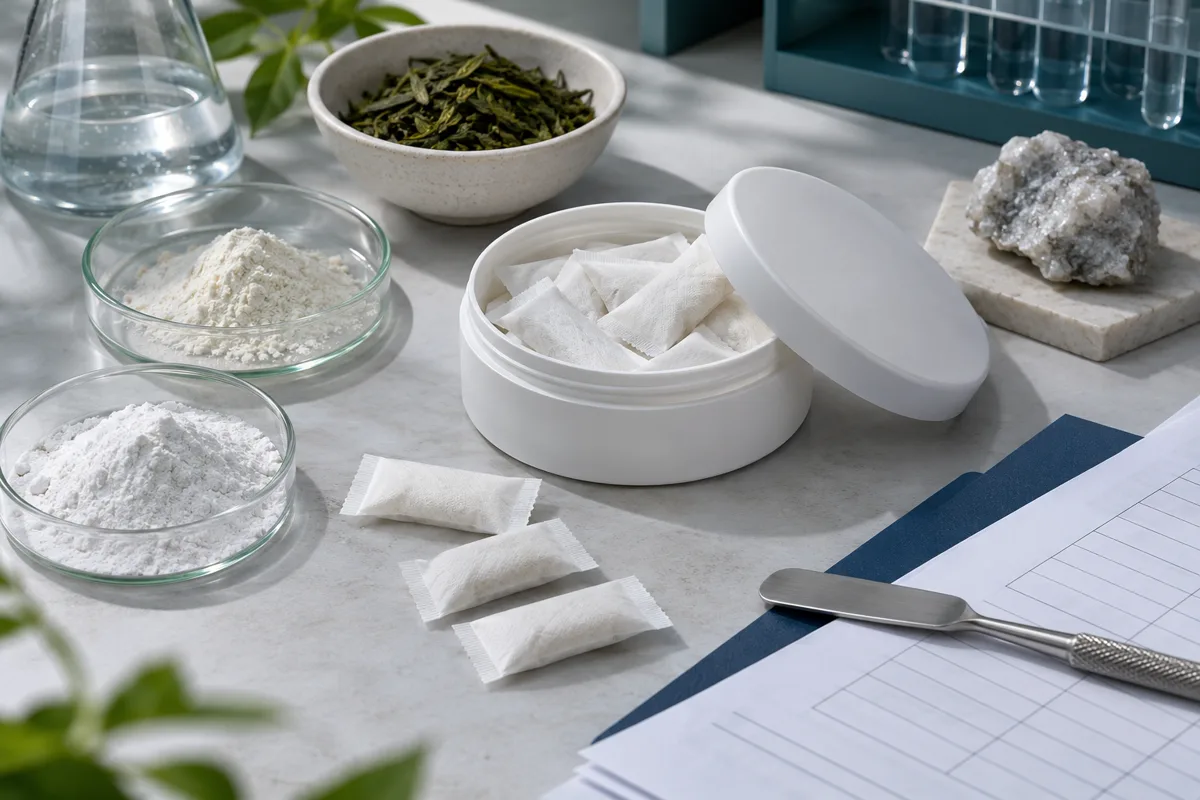

An oral pouch can should be accepted against two separate quantities: the number of finished pouches and the declared net contents. A can that feels full can still be short by one unit. Conversely, a correct unit count does not prove the declared content weight. Private label buyers should put both checks, the sampling plan and the response to a failed can in the purchase specification before the first commercial run.
This guide covers filled functional oral pouches packed in retail cans. It is a factory acceptance plan, not a substitute for the destination market’s legal metrology procedure.

What should the approved SKU specification state?
Start with the exact label declaration and the physical unit that will be sold. Record the nominal pouch count, nominal fill mass per pouch, declared net quantity if used, can-and-lid tare range and the approved moisture range. This prevents a pack-line team from treating a heavier lid or a wetter pouch as evidence that the right number of units was packed.
Keep count and mass in separate fields
- Retail unit: SKU, formula revision, pouch size, can and closure revision.
- Quantity declarations: pouches per can and net contents, with their units and market-specific artwork.
- Controls: target fill mass, can tare range, approved checkweigher setup and direct-count inspection.
- Traceability: lot, shift, machine, counter setting and inspector.
The oral pouch can comparison helps buyers specify the actual container; the blend and fill-weight guide explains why unit mass can drift before packing.
Can a checkweigher replace a direct count?
No. Weight is useful for screening cans at production speed, but overlapping weight distributions make it an imperfect proxy for unit count. A missing light pouch can be masked by heavier remaining pouches, moisture uptake or a can at the top of its tare range. Validate any weight-based reject threshold against deliberately prepared short- and over-count cans from the approved SKU.
| Check | What it detects well | What it cannot prove alone |
|---|---|---|
| Direct count of opened can | Missing or extra units | Net mass or active content |
| Empty-can tare plus contents mass | Gross under- or overfill | Exact number of pouches |
| Finished-pouch mass sample | Fill distribution | Retail-can count |
| Finished-unit assay | Measured active amount | Can count or label artwork |
How should a buyer sample finished cans?
Take sealed cans from the beginning, middle and end of a run, and after relevant interventions such as a counter reset or material change. Randomize locations within those periods. Open the selected retail units, count by hand, record the intact-can weight, separate contents mass from the measured can-and-lid tare, and retain the lot-linked record. The sample size and pass criteria should be agreed for each SKU and market rather than copied from a generic blog table.
For US net-content work, the current NIST Handbook 133 (2026) provides procedures for packages labeled by weight and by count. It is aimed primarily at officials but is also useful to manufacturers. Its rules are more specific than a casual “plus or minus one pouch” allowance, so have the destination-market specialist confirm the applicable test before release.
What happens when one can fails?
Hold the affected lot while the factory establishes the event window. Review counter logs, checkweigher rejects, manual rework, can jams and any change in pouch or can tare. Expand inspection around the suspected interval, then document disposition and corrective action. Do not average a short-count can against an overfilled one and call the lot acceptable without applying the relevant quantity procedure.
The batch traceability guide explains how lot codes and retain samples support this investigation. For a new private-label SKU, ask the OEM to include a witnessed count challenge in the pilot batch and send the raw result sheet, not only a one-line “pass” certificate.
Sources and scope
- NIST Handbook 133, 2026 edition, chapters on labeled weight and count.
- NIST net-contents FAQ, average and individual package requirements.
Editorial review: 16 November 2026. The procedures above are proposed buyer controls; no tested Linkbiolabs lot or universal legal tolerance is asserted.
Frequently asked questions
Does a correct can weight prove the pouch count is correct?
No. Can tare, pouch fill-weight variation and moisture can mask a missing or extra pouch. Check the count directly and weigh contents separately.
Should the count check use an unopened retail can?
Yes. A sealed retail can tests the actual packing process. Keep the sampled can, lot number and result linked in the inspection record.
Can an OEM use one universal tolerance for every pouch SKU?
No. Set SKU-specific limits from the approved label, package type, validated process and destination-market requirements.
What should happen after a short-count can is found?
Quarantine the affected lot, investigate the counter or pack-line event, define the inspection scope and document disposition before release.