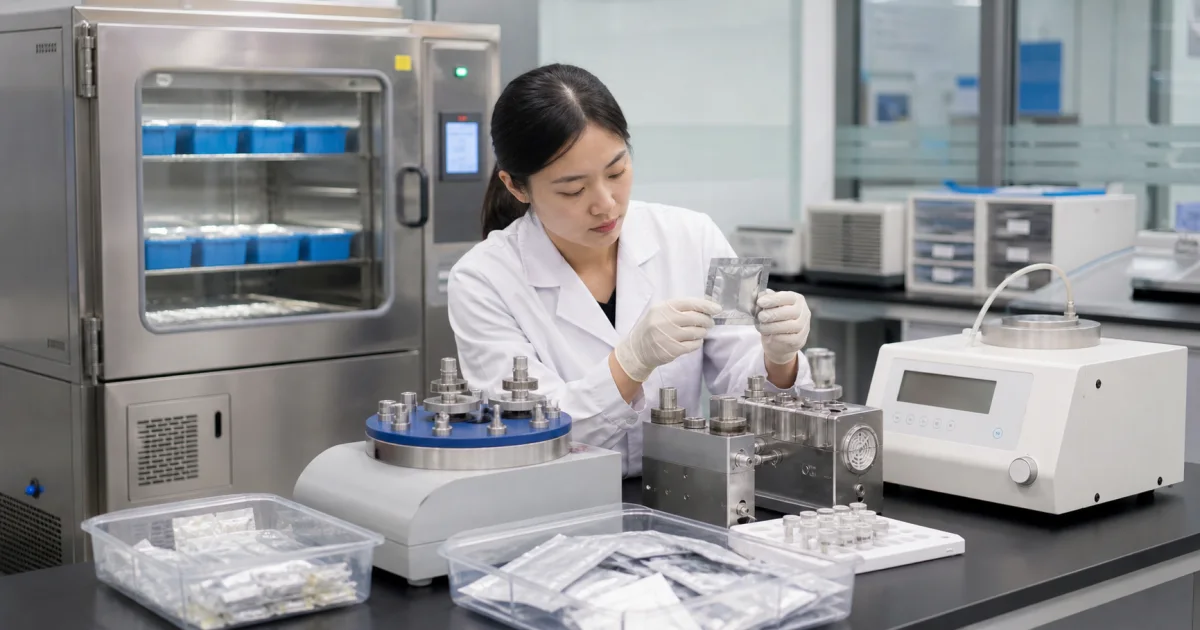
Oral pouch powder flow and blend segregation directly affect fill-weight uniformity, dose consistency and packaging-line efficiency. A blend can meet assay when sampled from the mixer yet separate during discharge, transfer or hopper residence. The result may be heavy and light pouches, changing flavor intensity or inconsistent levels of low-dose functional ingredients.
This article focuses on nicotine-free caffeine, guarana and nootropic oral pouch production for OEM and private-label buyers.
Why functional pouch blends segregate
Segregation occurs when ingredients differ in particle size, density, shape or surface properties. Fine particles may sift through gaps between larger particles. Dense particles may move differently during vibration, while very light botanical powders can remain near the top of a hopper. Repeated transfer, long drops and machine vibration can undo an initially uniform mix.
Moisture adds another variable. Hygroscopic materials may form soft agglomerates, while flavor oils can create tacky regions. A blend that flows well immediately after mixing may behave differently after conditioning or an open hold period.
Common powder-flow indicators
| Measurement | What it helps describe | Limitation |
|---|---|---|
| Bulk and tapped density | Packing behavior and compression | Does not reproduce every machine condition |
| Angle of repose | Comparative flow tendency | Sensitive to method and operator setup |
| Flow-through-orifice time | Discharge consistency | Some cohesive blends may not flow freely |
| Particle-size distribution | Risk of sifting and separation | Shape and surface chemistry also matter |
| Moisture or water activity | Clumping and stability risk | Total moisture and available water differ |
Design compatible particle distributions
Making every ingredient extremely fine is rarely the answer. Very fine powders can become cohesive, dusty and difficult to dose. A broad distribution may pack efficiently but can also sift during handling. The formulation team should select carriers and ingredient grades that provide repeatable flow while supporting dissolution and sensory requirements.
Low-dose ingredients need a controlled dilution strategy before entering the main mixer. The pre-blend should be designed to avoid large density differences and should be protected from de-mixing during later additions.
Optimize mixing without overprocessing
Mixing time must be long enough to achieve uniformity but not so aggressive that particles break down, heat builds or the blend separates by size. Addition order, mixer fill level, speed and batch size all influence performance. Scale-up should not rely only on matching minutes; equipment geometry and energy input change with production size.
Blend-uniformity samples should represent different mixer locations. After acceptable mixing is demonstrated, samples from discharge and the filling hopper help determine whether transfer creates new variation.
Control the hopper and filler
Hopper level changes can alter head pressure and feed consistency. Bridging, rat-holing or inconsistent agitation may create periodic weight shifts. Excess agitation can also promote segregation. The OEM should establish a working hopper range, refill method and maximum residence time.
Statistical review of individual pouch weights is more informative than a batch average. The trend can show gradual drift, cyclic variation or isolated outliers. When dose depends on a low-level ingredient, finished-unit content uniformity remains necessary; weight alone cannot prove active uniformity.
OEM process-control checklist
- Approve particle-size and density specifications for critical ingredients.
- Document pre-blend strategy and ingredient addition order.
- Validate mixer load, speed and mixing time at commercial scale.
- Sample mixer, discharge, transfer and hopper locations.
- Define hopper refill level and maximum hold time.
- Trend individual fill weights by lane and time.
- Link weight variation with finished-pouch assay and sensory data.
Frequently asked questions
Does good average fill weight prove uniformity?
No. Heavy and light units can average to the target. Individual results, variation and time-based trends are needed.
Can a flow aid solve every segregation issue?
No. Flow aids may improve handling, but particle size, density, transfer design, moisture and hopper operation must be assessed together.
Why does the first part of a batch differ from the last?
Transfer segregation, hopper residence, vibration or changing feed conditions may cause material at different production stages to have different composition or flow.
See the functional pouch dose-control guide, caffeine HPLC testing guide and OEM sample checklist. Buyers can request manufacturing support.