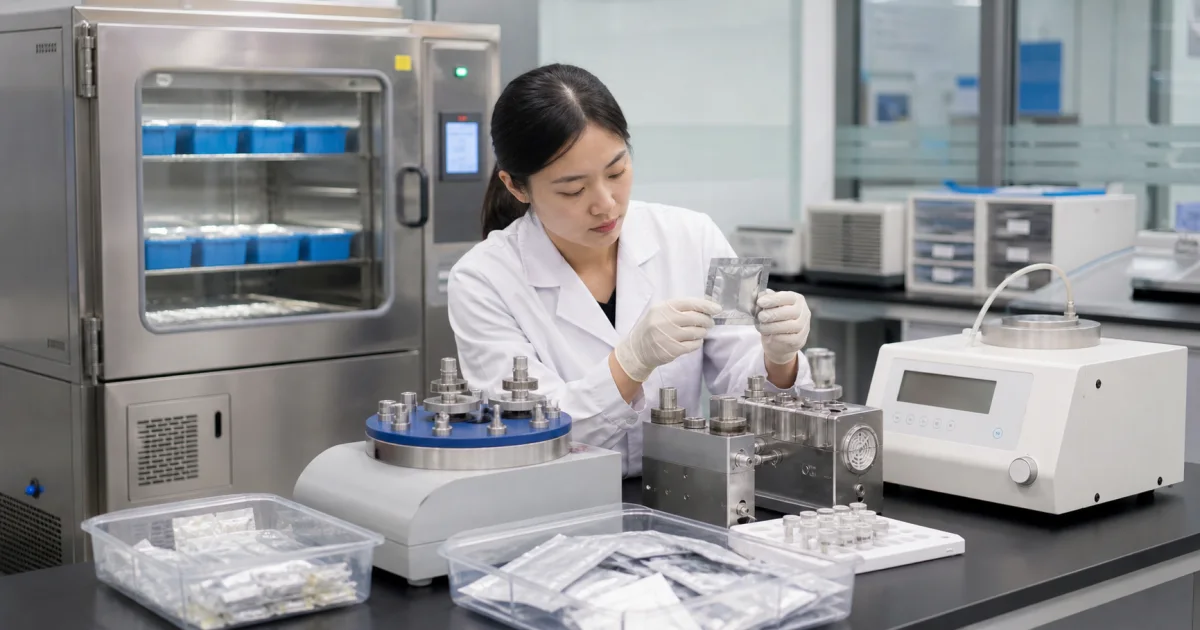
Oral pouch heat-seal validation proves that the pouch seam remains closed during filling, packing, transport, storage and the intended use period. A visually neat seal is not enough. The OEM must establish a repeatable operating window for temperature, pressure, dwell time, web alignment and seal width, then verify seam performance with physical tests and an appropriate sampling plan.
This guide covers nicotine-free functional oral pouches, including caffeine, guarana and nootropic formats. It is written for sourcing, product-development and quality teams.
Why oral pouch seals fail
Nonwoven pouch materials are porous and can vary in fiber structure, thickness and heat response. Powder trapped in the sealing zone can interrupt bonding. Excess heat may shrink, harden or weaken the fabric, while insufficient heat or dwell time may create an incomplete seal. Machine speed, jaw wear and uneven pressure also contribute to variation.
Formulation matters as well. Fine powders, oils, humectants and high-moisture blends can contaminate the seal area or change wet strength. Validation should therefore use the final commercial fabric and formula rather than an empty pouch strip.
Heat-seal parameters and their effects
| Parameter | If too low | If too high |
|---|---|---|
| Temperature | Weak or incomplete bonding | Fabric distortion, brittleness or burn-through |
| Pressure | Discontinuous seal contact | Compressed edge or material damage |
| Dwell time | Insufficient heat transfer | Lower line speed and excess thermal exposure |
| Seal width | Small safety margin | Less internal fill space and a stiff edge |
| Jaw alignment | Uneven pressure across the seam | Localized stress and variable appearance |
Build a validated sealing window
A single machine setting is not a robust process. During development, the manufacturer should challenge combinations near the expected upper and lower operating limits. This identifies a region where acceptable seals are consistently produced despite normal variation in material, room conditions and line speed.
The study should record actual jaw temperature rather than only the controller set point. Pressure, dwell time, speed, seal width, material lot and formula batch should be traceable. Start-up, restart, splice and end-of-roll samples deserve separate attention because transient conditions may differ from steady production.
Useful seam and leak tests
Peel or tensile testing provides a numerical comparison of seam strength under defined loading. Results depend on sample width, orientation, pull speed and conditioning, so the method must be consistent. Visual inspection should record channels, wrinkles, powder inclusion, thinning and edge damage.
Leak testing can use a validated pressure, vacuum, dye or liquid-exposure method appropriate to the pouch design. Wet-condition testing is especially important because the fabric and seal may soften after moisture exposure. No single test describes every failure mode; numerical strength, visual quality and functional leakage should be reviewed together.
Connect sealing with the filling process
Overfilled or poorly centered pouches can push powder into the seam. Unstable powder flow may cause occasional heavy units even when average fill weight is correct. The validation batch should include normal production variability and the intended maximum fill weight.
Maintenance controls also matter. Seal jaws can accumulate residue or wear unevenly. Cleaning frequency, inspection points and replacement criteria should be documented. Operators need clear limits for stopping and segregating material after an alarm or visible defect.
OEM buyer checklist
- Approve the exact nonwoven fabric and seam geometry.
- Review the validated temperature, pressure, dwell-time and speed window.
- Confirm dry and wet seam test methods and acceptance criteria.
- Include start-up, restart and end-of-roll samples.
- Challenge the maximum intended fill weight.
- Document jaw cleaning, calibration and preventive maintenance.
- Retain aged samples to confirm seam performance through shelf life.
Frequently asked questions
Can seam appearance replace strength testing?
No. Appearance identifies obvious defects, but a visually uniform seam can still be mechanically weak or contain an invisible leak path.
Should empty and filled pouches use the same limits?
Empty-pouch trials are useful for setup, but commercial validation should use the actual formula and fill-weight range because powder and moisture affect sealing.
How often should seal strength be checked?
The frequency should be risk-based and supported by process capability, line speed, material variability and the manufacturer’s quality system.
Related resources include our functional oral pouch manufacturing guide, dose-control guide and low-drip pouch formulation guide. For an OEM review, contact our development team.
Compliance note: validation methods and release criteria should reflect the product design, quality system and destination-market requirements.