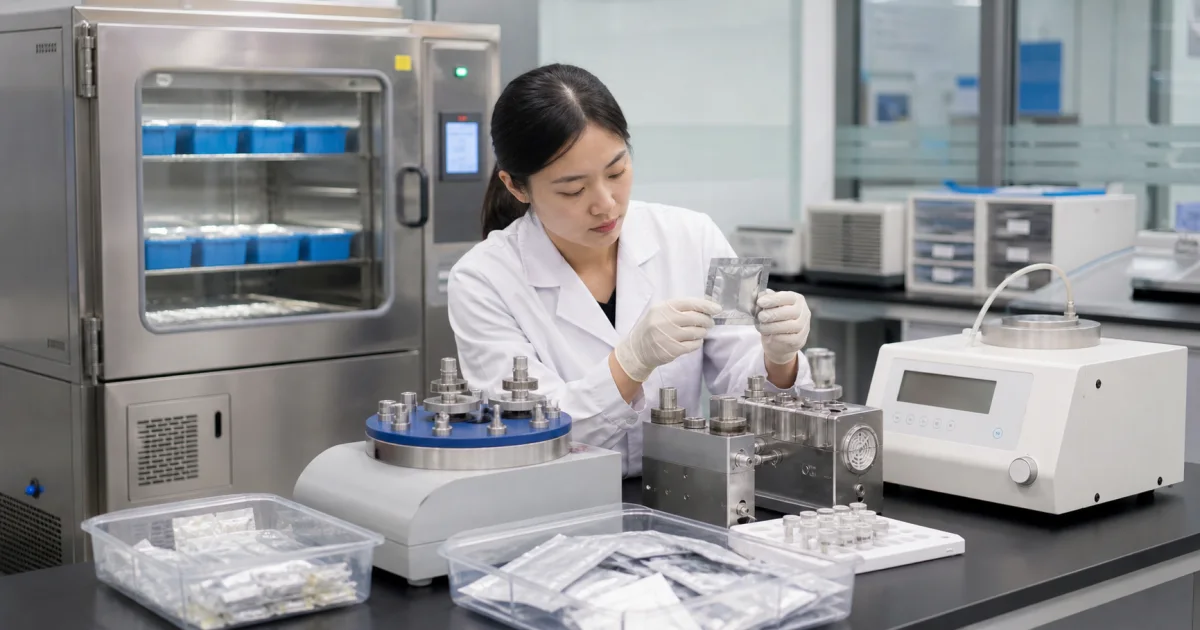
ODF slitting and cutting accuracy determines whether every orodispersible film unit has the intended dimensions, mass, edge quality and position inside its sachet. A coating roll may pass assay and thickness checks but still produce unacceptable finished units if the web tracks poorly, blades wear, film tension changes or the cutting system loses registration. For an OEM buyer, converting controls should therefore be included in the product specification and validation plan.
This guide is written for private-label and contract-manufacturing teams working with functional ODF products such as caffeine and melatonin oral films.
Why converting accuracy matters after film casting
ODF manufacturing does not end when the wet film is dried. The roll must be conditioned, released from its liner where applicable, slit into narrower lanes, cut into individual units and transferred into barrier sachets. Each step can change dimensions or damage the film.
When active material is uniformly distributed through the film, unit area is closely related to unit mass and dose. An inaccurate cut can therefore affect more than appearance. It may change the amount of film material in the sachet, complicate content-uniformity results or cause the strip to overlap the seal area.
Critical ODF slitting and cutting controls
| Control point | Potential defect | Useful verification |
|---|---|---|
| Web tension | Stretching, curl or dimensional drift | Tension trend and unit-dimension sampling |
| Web alignment | Uneven lane width or off-center cuts | Edge guide and vision inspection |
| Blade condition | Ragged edges, dust or incomplete cuts | Magnified edge inspection and blade-life record |
| Registration sensor | Film placed near or inside sachet seal | Camera challenge and reject verification |
| Film moisture | Sticking, cracking or deformation | Residual moisture and room-humidity checks |
| Cut length and width | Area and unit-mass variation | Calibrated dimensional measurement |
Control web tension without stretching the film
Thin polymer films can elongate under tension and contract after cutting. Excess tension may temporarily produce correct dimensions at the cutting station but smaller units after relaxation. Insufficient tension can create wrinkles, wandering and irregular cut lengths. The operating range should be established with the final film composition and residual-moisture target because flexibility changes with formulation and conditioning.
Start-up, roll-splice and end-of-roll material deserve special attention. These periods often show more tension variation than steady-state production and may require segregation until acceptable performance is confirmed.
Blade selection and edge-quality inspection
A sharp, correctly aligned blade should create a clean edge without tearing, powdering or pulling the film. Dull blades can generate small fragments that affect appearance and equipment cleanliness. Brittle film may crack beside the cut, while tacky film can adhere to the blade and distort subsequent units.
The manufacturer should define blade type, setup, inspection frequency and replacement criteria. Edge quality can be checked under controlled magnification, with defects classified by type and size. Merely stating that an edge is “clean” is too subjective for commercial batch control.
Link dimensions, unit weight and content uniformity
Dimensions should be measured at multiple lanes and time points, not only from a convenient sample near the operator. Unit mass is a fast in-process indicator that can reveal thickness, area or moisture variation. However, weight does not replace analytical assay and content-uniformity testing, especially when a low-dose active may not be distributed perfectly.
A useful investigation compares unit length, width, thickness, weight and assay. This helps distinguish a cutting problem from a coating or mixing problem.
Keep the ODF away from the sachet seal
The cut film must be transferred to a controlled position inside the sachet. If a strip enters the heat-seal zone, the package may leak or the product may adhere to the laminate. Registration sensors and camera systems should detect missing, doubled, folded and misplaced units. Challenge tests should demonstrate that the reject mechanism removes known defects.
Sachet dimensions need enough tolerance for reliable placement without using unnecessarily large packaging. The final design should be validated at target line speed, since a slow engineering trial may not reveal transfer instability.
OEM validation and purchasing checklist
- Define nominal film length, width, thickness and permitted tolerances.
- Specify sampling across every lane and throughout the converting run.
- Connect unit weight trends with assay and content-uniformity data.
- Approve edge-defect classifications and blade-change criteria.
- Validate vision inspection for missing, doubled and misplaced films.
- Challenge the reject system at commercial operating speed.
- Confirm sachet seal integrity after transport and stability conditioning.
Frequently asked questions
Can ODF dose be controlled only by cutting area?
No. Cutting area is important, but dose also depends on coating uniformity, film thickness, active distribution and analytical assay.
Why do film dimensions change after cutting?
Stored web tension, residual moisture and ambient humidity can cause relaxation, shrinkage or expansion after the unit leaves the cutting station.
Does a camera system eliminate manual inspection?
No. Vision systems improve continuous detection, but they require validated settings, challenge tests, maintenance and periodic review of physical samples.
Continue with our ODF film thickness-control guide, ODF content-uniformity testing guide, ODF sachet packaging guide or discuss a private-label ODF project.
Compliance note: final release tests and acceptance criteria must reflect the product classification, formulation and destination-market requirements.