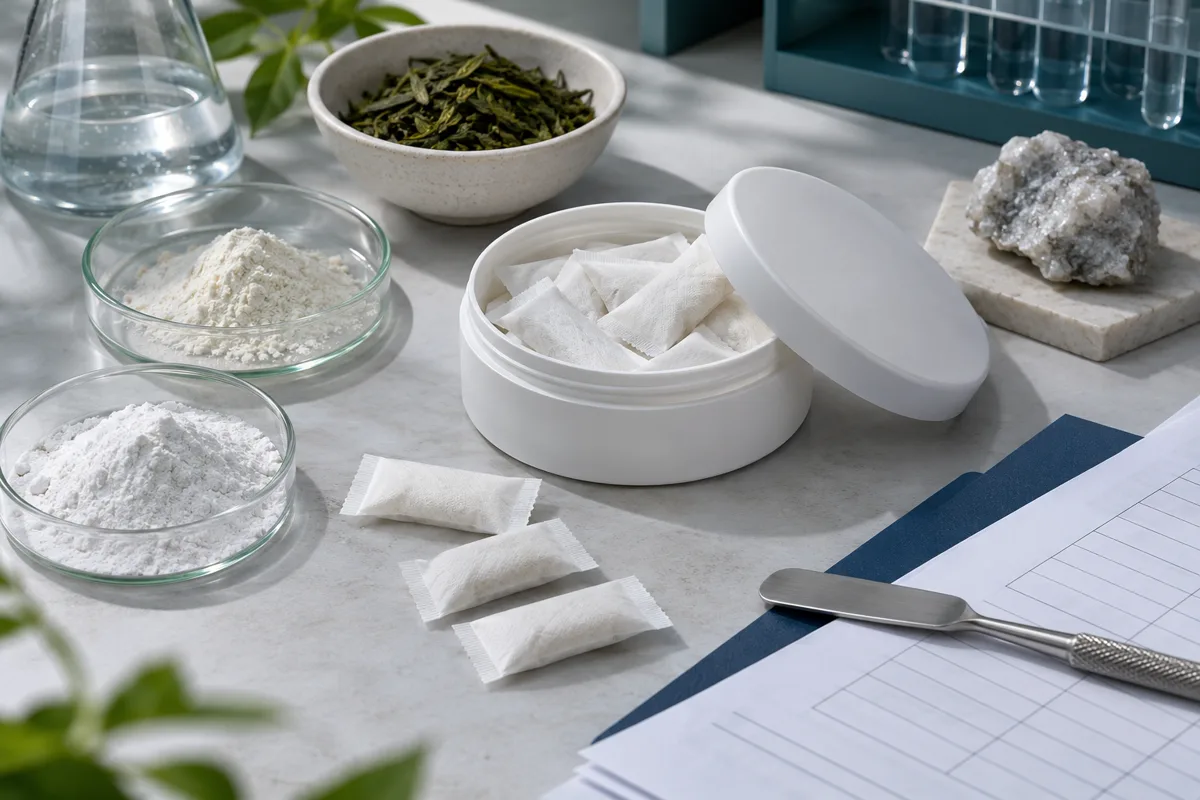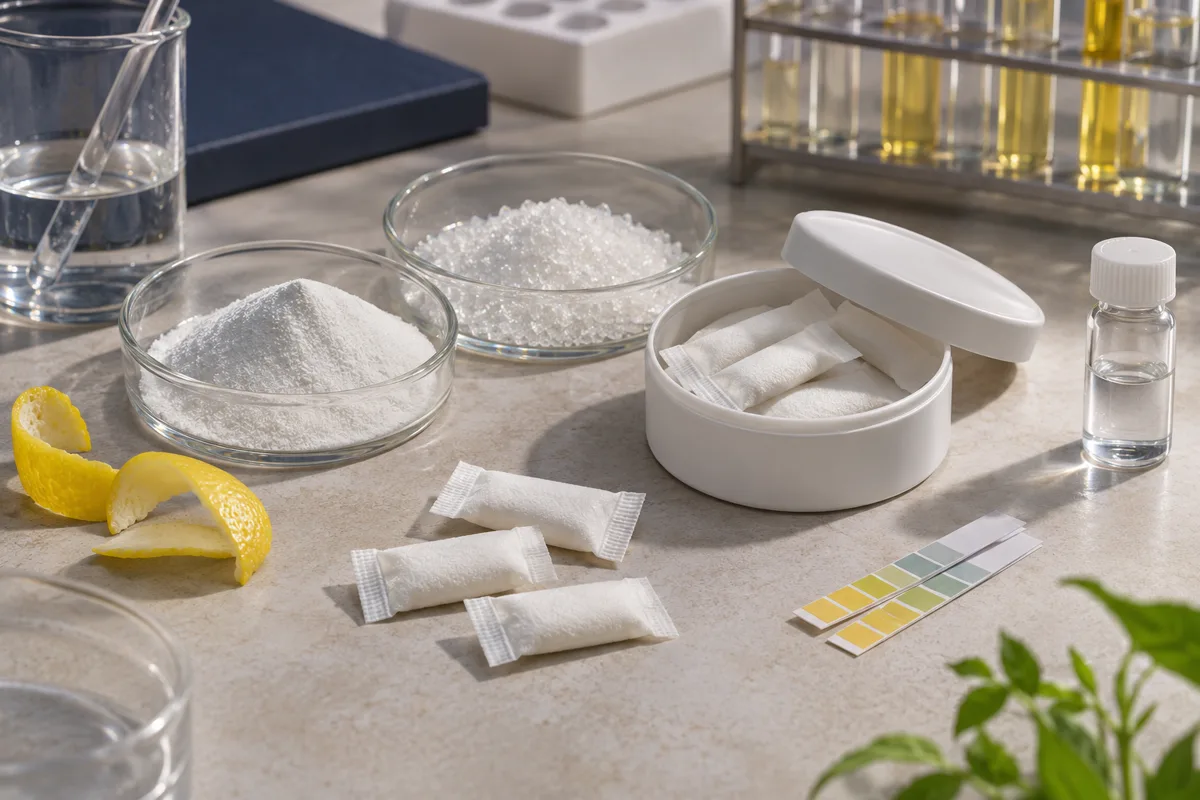

A caffeine-free stress-relief pouch brief should separate ingredient identity, finished-unit quantity and the proposed consumer claim. L-theanine and magnesium may be considered for a daytime functional pouch, but their presence in a formula does not prove that the finished product relieves stress or anxiety. Brands should write the intended market and claim first, then ask the OEM for two testable prototypes and a method to measure what is actually in each pouch.
This is a product-development guide for stress-relief pouches, not medical advice or an efficacy claim. See the separate caffeine-free nootropic pouch guide for broader ingredient options.
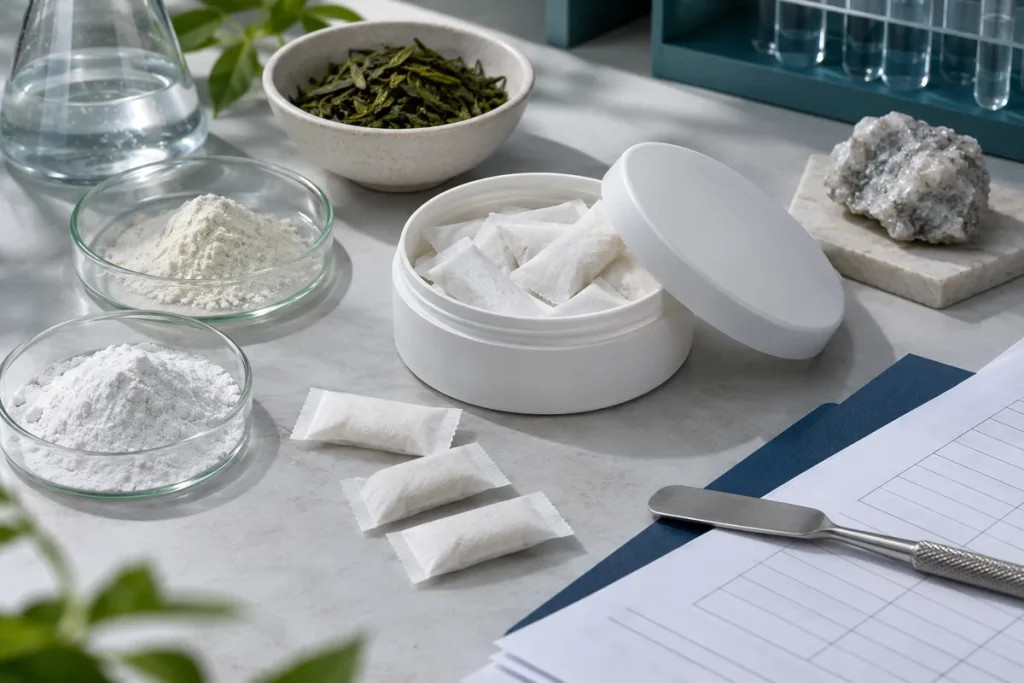
What should the formulation brief specify?
Define “caffeine-free” analytically and commercially before selecting ingredients. The brief should prohibit added caffeine and require review of botanical inputs that may contribute it. Specify the target amount per finished pouch, intended use period, pouch size, moisture profile, flavor and can. For magnesium, name the salt and state the target as elemental magnesium as well as raw-material input mass.
Give the OEM a measurable request
- Two formulas: an L-theanine-led option and a magnesium-led option, or a justified blend.
- Supplier identity, ingredient assay, allergen statement and lot for each input.
- Finished-unit content method, sampling positions and release limits.
- Blinded sensory results, mouthfeel observations and commercial-can stability plan.
Do not presume a particular dosage from ingredient marketing. The magnesium pouch guide explains elemental-dose arithmetic; the allergen control guide addresses supplier and changeover documentation.
How do L-theanine and magnesium differ for buyers?
L-theanine is an amino acid associated with tea; magnesium is a mineral supplied through salts with different elemental fractions and sensory properties. The analytical method and label calculation are therefore different. A buyer should compare each candidate on identity, finished-unit amount, taste, moisture behavior and market-specific claim options, rather than rank ingredients by a general “calm” score.
| Control point | L-theanine route | Magnesium route |
|---|---|---|
| Input definition | Identity, purity and any tea-derived caffeine carryover | Salt identity and elemental magnesium fraction |
| Finished-unit result | L-theanine assay in the complete pouch | Elemental magnesium result in the complete pouch |
| Sensory check | Flavor balance and finish | Mineral taste, texture and mouthfeel |
| Claim review | Product and market-specific evidence | Applicable nutrient-claim conditions and product status |
Can the brand say “reduces anxiety” or “clinically calming”?
Do not write either phrase from an ingredient list. In the US, FDA separates label-claim categories, while the FTC requires competent and reliable scientific evidence for advertising claims. An anxiety-treatment message may imply a disease claim. Review the finished product, consumer takeaway, formulation and use instructions before approving any health language.
In the EU, Regulation 432/2012 includes a magnesium claim about normal psychological function, subject to conditions. That is not a blanket authorization for a stress-relief oral pouch or for L-theanine. A market specialist must assess product classification, claim conditions and translation.
How should prototypes be accepted?
Request the same pouch fabric, can and target shelf life for both options so differences are interpretable. Test finished units from multiple parts of the pilot run, then study content and sensory drift in the intended retail pack. Keep panel preference separate from any biological-effect claim. A pleasant mint flavor can improve acceptance, but it cannot verify stress reduction.
Ask the OEM to document the final formula revision, assay method, artwork claim review and release specification together. That packet makes a reorder safer than a sample jar and a marketing slide deck alone. The artwork approval guide provides a version-control checklist.
Sources and scope
- US FDA: label claim categories.
- US FTC: Health Products Compliance Guidance.
- EU Regulation 432/2012: magnesium claim conditions.
Editorial review: 16 November 2026. No finished formula is claimed to treat anxiety, reduce stress or meet a specific market’s regulatory pathway.
Frequently asked questions
Are caffeine-free pouches automatically calming?
No. Caffeine-free describes the absence of added caffeine in the intended formula; a calming effect needs evidence for the specific finished product and claim.
Should magnesium be listed as the salt weight or elemental magnesium?
Specify both in the formulation brief. Consumer nutrient declarations and claim conditions generally concern elemental magnesium, subject to market rules.
Can a supplier certificate replace a finished-pouch assay?
No. Supplier identity and input tests do not establish how much of each ingredient is present in each finished pouch.
Is an anxiety-treatment claim suitable for a functional pouch?
Do not use a disease-treatment claim without a market-specific legal pathway and adequate evidence. Review labels and advertising separately.