
Private-label magnesium oral pouches should be specified by elemental magnesium per finished pouch, not by the weight of a magnesium salt added to the mixer. The salt choice also affects powder flow, taste, moisture behavior and the amount of material that fits inside a slim pouch. Before approving a concept, ask for a calculation that connects the raw-material assay to the finished-unit assay and to the proposed label.
This is a formulation and procurement guide for nutritional oral pouches. It does not establish that a particular magnesium pouch is permitted in every market or that a pouch delivers a clinical benefit.
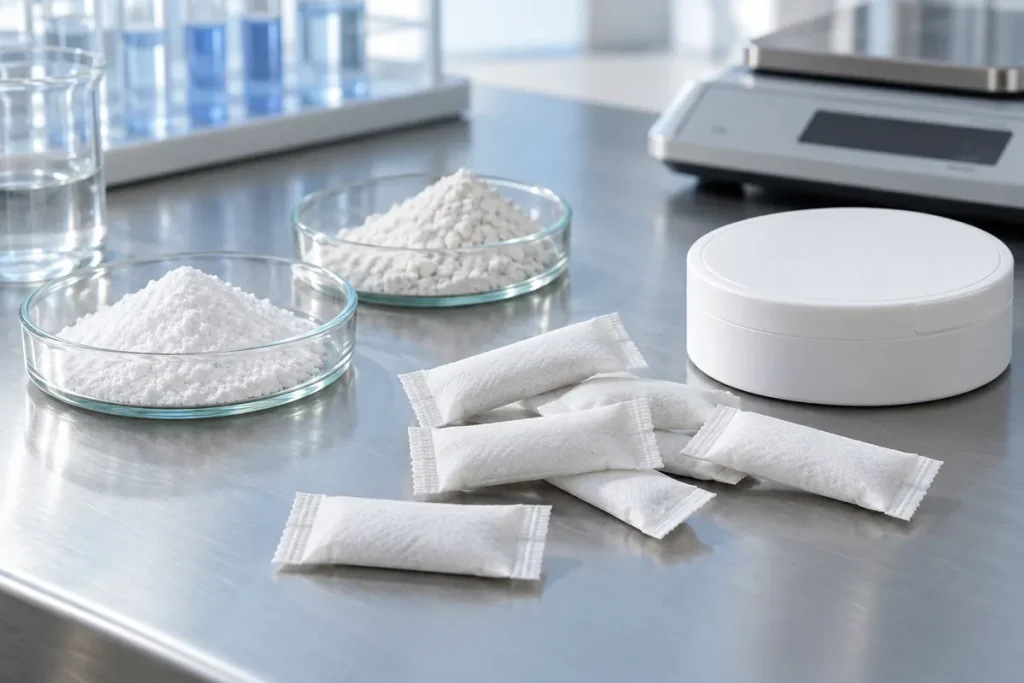
What does “elemental magnesium per pouch” mean?
It is the mass of magnesium itself in one finished pouch. A magnesium compound has a larger total mass because it also contains other atoms or molecules. The NIH Office of Dietary Supplements explains that a US Supplement Facts panel declares elemental magnesium rather than the weight of the entire magnesium-containing compound. A buyer who requests “50 mg magnesium citrate” and a buyer who requests “50 mg elemental magnesium from magnesium citrate” have asked for different formulas.
Put both numbers in the formulation brief: the compound input per pouch and the calculated elemental contribution. Then confirm the supplier’s stated assay, hydration state and batch-specific certificate of analysis. The finished-product result should be reported per pouch, with a sampling plan covering the beginning, middle and end of the fill run. The calculation is a starting point; it does not replace a suitable finished-unit test.
| Specification field | What the buyer should request | Why it matters |
|---|---|---|
| Salt identity | Exact chemical form, grade and supplier | Similar commercial names can describe different materials |
| Elemental contribution | Calculated mg per pouch with assay basis | Prevents salt weight from being presented as magnesium weight |
| Finished-unit result | Validated or verified assay in the pouch matrix | Checks actual filling and blend uniformity |
| Label basis | Serving definition and destination-market review | Connects analytical result to consumer-facing copy |
Which magnesium salt should a pouch prototype use?
Choose the salt after bench testing, not from a bioavailability ranking alone. The NIH fact sheet notes that magnesium forms differ in solubility and absorption when consumed as supplements. Those findings do not establish how much magnesium a new oral-pouch formulation releases in the mouth or how it feels against oral tissue. A citrate, chloride or oxide route may behave differently in taste, pH, flow and moisture pickup.
Screen at least two candidate materials in the intended pouch fabric and sweetener system. Record fill-weight variation, clumping after humid storage, mouthfeel, residual grit and flavor change. If a prototype is too bulky for a slim pouch, changing salt form or target amount is a formulation decision that must be reflected in the label brief. Keep the selected supplier and grade fixed for pilot work; a different source can change particle size and sensory behavior even when the chemical name matches.
What testing belongs in the OEM purchase specification?
Separate incoming-material evidence from finished-unit evidence
A useful specification separates incoming-material checks from finished-pouch checks. For the ingredient, request identity, assay basis, relevant contaminants and the certificate tied to the delivered lot. For the pouch, agree a per-unit magnesium assay, fill-weight variation, microbiological limits where appropriate, package integrity and stability under the intended storage conditions. The method needs to work in the full matrix, not only in a pure salt solution.
An ISO/IEC 17025-accredited laboratory can be a useful third party, but accreditation is not a substitute for checking the specific method and matrix on the laboratory’s scope. Ask how the analyst extracts magnesium from nonwoven fabric, fillers and flavors, and how recovery is demonstrated. Our COA versus specification guide explains why a supplier certificate, a release specification and an independent report answer different questions.
- Record the raw-material lot and its declared elemental assay.
- Agree the finished-unit method, recovery and acceptance range before scale-up.
- Sample across the manufacturing run rather than from one convenient can.
- Retain the approved flavor, fabric and packaging versions with the test report.
How should safety and label review be handled?
Review total intake from all sources and the product’s regulatory category in each destination market. The NIH lists a 350 mg per day tolerable upper intake level for supplemental magnesium in adults; it does not include magnesium naturally present in food. That figure is not a suggested pouch dose, a per-pouch legal limit or a guarantee of safety for an individual. Kidney disease, medicines and other supplements can change the risk assessment.
For a US dietary supplement, FDA labeling rules require the appropriate Supplement Facts information, including serving size and ingredient amounts. Whether a particular oral-pouch presentation qualifies for that route needs a separate classification review. Keep the first artwork proof free of disease-treatment language and send the formula, intended use and draft label to a qualified reviewer before printing. A claim about absorption or rapid effect needs product-specific evidence, not an inference from the ingredient name.
Sources and scope
- NIH Office of Dietary Supplements: magnesium forms, elemental labeling and supplemental upper intake levels.
- US FDA: dietary-supplement labeling questions and answers.
- ISO/IEC 17025:2017: laboratory competence standard.
Editorial review: 29 October 2026. Example specification fields are buyer-planning items, not a claim that Linkbiolabs has tested or released a magnesium pouch SKU.
Frequently asked questions
Is 50 mg magnesium citrate the same as 50 mg elemental magnesium?
No. Magnesium citrate includes other atoms, so 50 mg of the compound contains less than 50 mg of magnesium itself. Specify the elemental amount and verify the finished pouch.
Can a raw-material certificate prove the magnesium amount in every pouch?
No. The ingredient certificate documents the incoming lot. Finished-unit testing and representative run sampling are needed to assess the amount in pouches.
Is the NIH 350 mg upper limit a legal maximum for each pouch?
No. NIH gives that figure as an adult daily upper intake level for supplemental magnesium, not a pouch-specific legal limit or suggested dose.
Does a soluble magnesium salt prove fast absorption from an oral pouch?
No. Ingredient solubility does not establish release or human absorption from a particular finished pouch. Those claims need product-specific evidence.