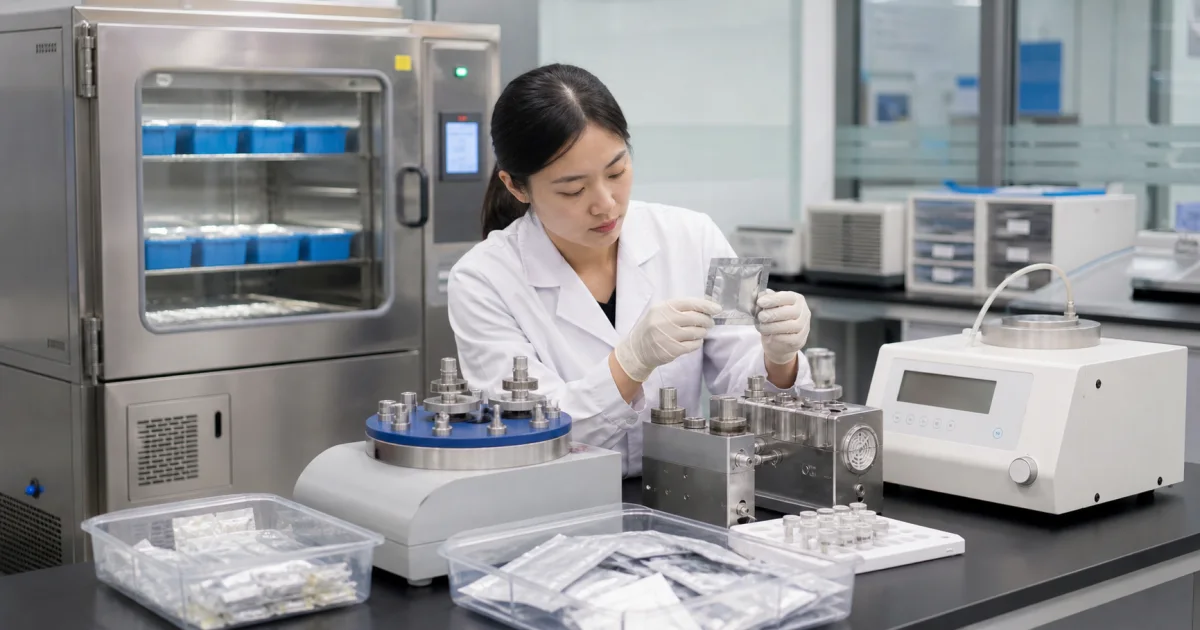
Learning how to make low-drip caffeine pouches starts with controlling how quickly saliva enters the pouch and how quickly dissolved ingredients leave it. A pouch can feel dry at first yet become wet and leaky after ten minutes if the fabric, powder structure, humectant system and fill weight are not designed together. For a private-label buyer, “low drip” should therefore be converted into measurable development targets rather than treated as a flavor description.
This guide covers nicotine-free functional pouches only. It is written for brand owners, distributors and OEM product teams and does not provide medical advice.
What does low drip mean in an OEM specification?
Low drip normally means that the pouch remains comfortable and structurally stable while limiting uncontrolled liquid release. It does not mean zero moisture movement. The pouch still needs enough wetting to release flavor and soluble ingredients consistently. A useful specification combines laboratory measurements with a timed sensory panel.
| Control point | What it influences | Useful evaluation |
|---|---|---|
| Pouch fabric | Saliva entry, seam stability and surface feel | Basis weight, pore structure and wet tensile strength |
| Particle-size distribution | Powder packing and liquid pathways | Sieve profile and blend flow |
| Humectant system | Initial softness and water retention | Water activity and mass change |
| pH and buffering | Taste, ingredient stability and oral sensation | Initial and time-point pH |
| Fill weight | Pouch thickness and free volume | Unit-weight variation and compression |
Start with the pouch material, not only the powder
Two nonwoven fabrics with the same nominal weight can behave differently because fiber type, bonding pattern and pore distribution change capillary flow. A very open structure can wet rapidly and release liquid quickly. A very dense structure may delay wetting but create an uneven first-use experience. OEM trials should compare candidate fabrics using the same fill blend, seam geometry and pouch dimensions.
Wet tensile strength matters because a pouch that softens too far can stretch, wrinkle or stress the heat-sealed edge. Buyers should request both dry and wet handling observations rather than approving a material from a dry sample alone.
Balance moisture, humectants and water activity
Added water can improve softness, but total moisture is not the same as available water. Water activity is the more useful stability indicator because it helps the manufacturer understand microbial risk, texture drift and moisture migration. Humectants can hold water within the matrix, yet excessive use may create sweetness, tackiness or faster liquid transfer.
A practical development matrix tests at least three moisture levels and two humectant ratios. Samples should be packed in the intended can, conditioned, then retested after temperature and humidity exposure. This reveals whether an attractive fresh sample will remain low-drip after storage and transport.
Control powder structure and soluble load
Fine particles increase surface area and may dissolve quickly, while a broad particle distribution can create dense packing and inconsistent flow. Highly soluble flavor carriers, acids, sweeteners and caffeine systems also change osmotic behavior. The goal is not simply to make every ingredient finer. The goal is a repeatable blend that fills cleanly, wets evenly and avoids localized high-concentration zones.
Pre-blend order should be documented. Low-dose ingredients require an appropriate dilution strategy before addition to the main blend. Finished-pouch assay and unit-to-unit uniformity confirm that mouthfeel improvements have not compromised dose consistency.
Use a timed saliva-uptake and drip protocol
- Record initial pouch mass, dimensions and seam appearance.
- Expose replicate units to a controlled test medium or validated sensory protocol.
- Measure mass gain at defined time points such as 5, 10, 20 and 30 minutes.
- Record external wetness, liquid release, deformation and seam condition.
- Compare results with flavor intensity and ingredient-release data.
The exact method should be developed and validated by the manufacturer. Results are most useful when the same conditions are applied to every prototype and reference product.
OEM buyer checklist
- Define the intended use duration and acceptable external wetness.
- Approve pouch size, fabric grade, seam width and fill-weight tolerance.
- Review water activity, microbiology and accelerated stability data.
- Ask for a timed sensory score covering drip, mouthfeel and flavor longevity.
- Confirm caffeine assay and finished-unit uniformity.
- Retest after hot-climate shipping simulation if relevant.
Frequently asked questions
Does a drier pouch always drip less?
No. A dry pouch can absorb saliva rapidly and then release liquid if its fabric and powder structure are poorly matched.
Can thicker pouch fabric solve the problem?
Not by itself. Thickness, pore structure, fiber bonding, seam quality and fill formulation must be evaluated together.
Should low-drip claims appear on the label?
Only when the wording is permitted in the target market and supported by an appropriate product-specific test method.
Continue with our nicotine-free oral pouch sourcing guide, water activity and shelf-life guide or request an OEM formulation discussion.
Compliance note: product classification, ingredient permissions and claims vary by market. Verify current requirements before manufacture or sale.