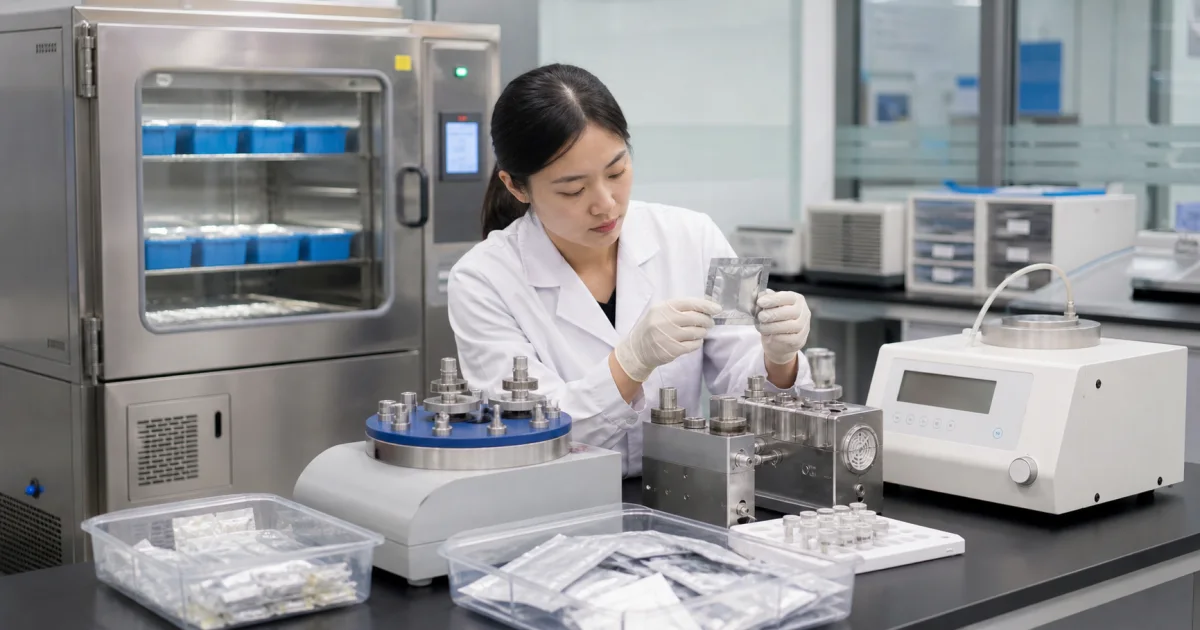
ODF disintegration vs dissolution testing answers two different development questions: when does the film lose its physical structure, and how quickly does a selected ingredient enter the test medium? A film can break apart quickly while an ingredient dissolves more slowly, especially when the formula contains poorly soluble actives, particles or strong interactions with the polymer matrix.
Private-label buyers should avoid using “fast dissolving” as the only specification. The OEM brief should define the method, medium, endpoint and product-specific acceptance criterion.
Disintegration and dissolution compared
| Test | Main question | Typical output | Development use |
|---|---|---|---|
| Disintegration | When does the film lose its coherent structure? | Time to defined physical endpoint | Polymer, thickness and user-format screening |
| Dissolution | How much marker or active enters solution over time? | Percentage or concentration profile | Ingredient release and batch comparison |
| Visual dispersion | How does the film fragment or hydrate? | Images and descriptive observations | Troubleshooting and sensory correlation |
Why method details change the result
Medium composition, volume, temperature, agitation, film placement and endpoint definition can all change measured time. A film attached to a vessel wall behaves differently from one fully exposed to moving liquid. Comparing supplier data is unreliable unless the methods are comparable.
For dissolution, the analytical method also needs suitable specificity, accuracy and range. Sampling should not remove enough liquid to change the experiment without correction. Filters and tubing must not adsorb the measured ingredient.
Connect the tests to film design
Thicker films usually require more hydration before losing structure, but polymer type and plasticizer can be equally important. Insoluble flavors, botanical particles and high active load may create weak points or slow ingredient release. A very rapid breakup is not automatically superior if the film becomes difficult to package or does not release the intended ingredient consistently.
Development should compare disintegration with film thickness, unit mass, tensile properties, residual moisture and sensory observations.
Build a practical sampling plan
Test units from different locations across the coated web and from the start, middle and end of a roll. This helps detect thickness or drying gradients. Finished sachets should be tested at release and during stability because moisture migration and polymer aging can change performance.
When the product contains a low-dose active, assay and content uniformity remain essential. Fast disintegration does not demonstrate that every film contains the correct amount.
What belongs in an OEM specification?
- Exact sample dimensions and conditioning requirements.
- Test medium, volume, temperature and agitation.
- Definition of the disintegration endpoint.
- Dissolution time points and analytical marker.
- Number and location of units sampled.
- Acceptance limits supported by development data.
- Stability time points and out-of-trend review.
Avoid unsupported absorption claims
Laboratory disintegration or dissolution data does not, by itself, prove faster absorption, improved bioavailability or a clinical benefit. Such statements require product-specific evidence and must comply with destination-market rules. Technical documentation should distinguish physical performance from biological outcomes.
Frequently asked questions
Can an ODF pass disintegration but fail dissolution?
Yes. The film may lose structure while an ingredient remains undissolved, precipitates or releases more slowly than expected.
Is a home glass-of-water test sufficient?
It can be a visual development screen, but it is not a controlled release or quality method unless conditions and endpoints are defined and validated.
Should every ODF use the same time limit?
No. The target should reflect the product design, ingredients, market requirements and validated manufacturing capability.
Continue with our ODF dissolving-speed guide, content-uniformity sampling guide and ODF contract manufacturing discussion.