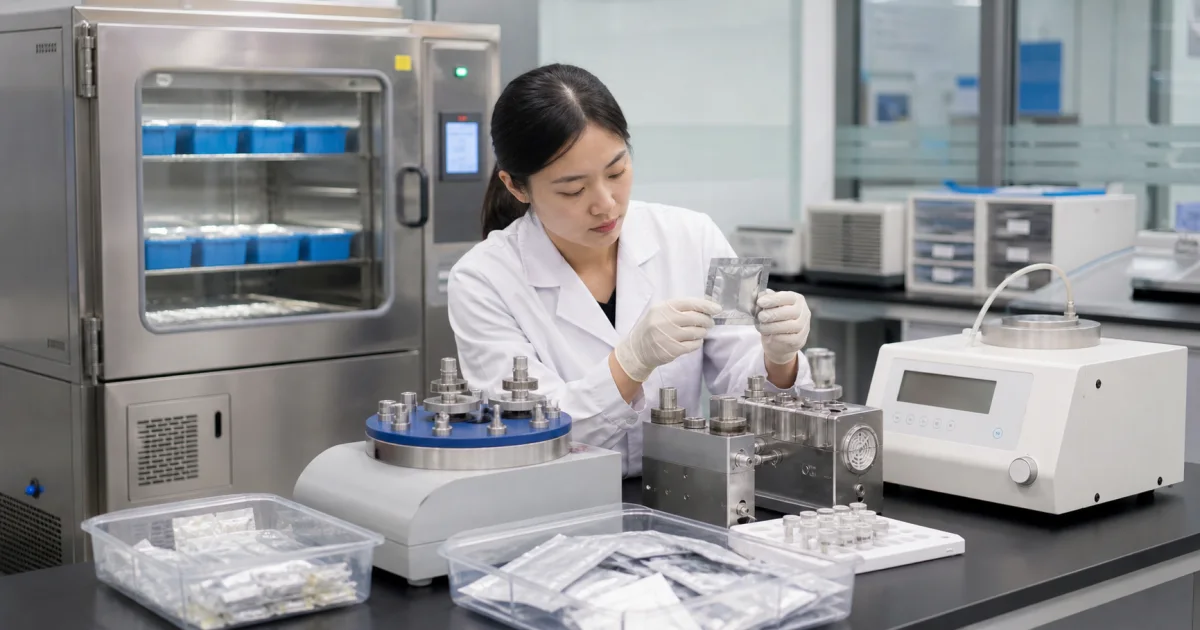
A label claim such as “50 mg caffeine per pouch” should be supported by finished-product data. A third-party HPLC test for caffeine energy pouches helps buyers detect under-strength, over-strength and blending inconsistency before a shipment reaches customs or retail.
Updated for 2026. This B2B guide is written for cross-border brand owners, wholesalers, distributors and DTC founders sourcing nicotine-free oral pouches.
What HPLC Measures
High-performance liquid chromatography separates and quantifies caffeine in a prepared sample. The laboratory method must be suitable for the actual matrix, because sweeteners, flavors and botanical extracts can interfere with extraction or detection.
Sampling Checklist
| Step | Buyer instruction |
|---|---|
| Define the lot | Record finished-batch number and manufacturing date |
| Select units | Pull unopened cans from multiple case positions |
| Set sample size | Ask the laboratory how many pouches and replicates are required |
| Protect chain of custody | Seal, label and document every sample |
| Test the finished product | Do not rely only on the raw-material COA |
What to Put on the Laboratory Request
- Caffeine in milligrams per pouch and, where useful, milligrams per gram.
- Replicate analysis or a composite plan appropriate to the batch.
- Method reference, reporting limit and measurement uncertainty.
- Sample identification matching the commercial lot.
- Accreditation scope and authorized report signature.
How to Review the Result
Compare the measured value with the approved specification—not only the front-label target. A sensible specification defines upper and lower tolerances based on manufacturing capability and regulatory requirements. Investigate unusual variability before averaging results into an apparently acceptable number.
COA Red Flags
Red flags include a report without a lot number, reused dates, no method, impossible precision, a result expressed only as raw-material percentage, or a laboratory whose accreditation does not cover the test. Add identity, microbiology, moisture and relevant contaminant tests according to formula and market.
Use the full quality framework in the 2026 sourcing guide.
Frequently Asked Questions
Does every batch need HPLC testing?
The frequency should be risk-based and documented. Many buyers require caffeine assay for every commercial batch.
Can the manufacturer issue its own COA?
Yes, but buyers may also require independent confirmation from a qualified third-party laboratory.
What does 20% guarana mean?
It usually refers to caffeine standardization of the extract, not caffeine per finished pouch. The final formula still needs calculation and verification.
{“@context”:”https://schema.org”,”@type”:”FAQPage”,”mainEntity”:[{“@type”:”Question”,”name”:”Does every batch need HPLC testing?”,”acceptedAnswer”:{“@type”:”Answer”,”text”:”The frequency should be risk-based and documented. Many buyers require caffeine assay for every commercial batch.”}},{“@type”:”Question”,”name”:”Can the manufacturer issue its own COA?”,”acceptedAnswer”:{“@type”:”Answer”,”text”:”Yes, but buyers may also require independent confirmation from a qualified third-party laboratory.”}},{“@type”:”Question”,”name”:”What does 20% guarana mean?”,”acceptedAnswer”:{“@type”:”Answer”,”text”:”It usually refers to caffeine standardization of the extract, not caffeine per finished pouch. The final formula still needs calculation and verification.”}}]}
Build Your Private Label Project
Linkbiolabs supports formulation, flavor development, sampling, pouch production and packaging coordination for caffeine pouches, guarana pouches, nootropic focus pouches, energy pouches and breaker formats. Send your target market, formula brief and forecast for a project-specific review.