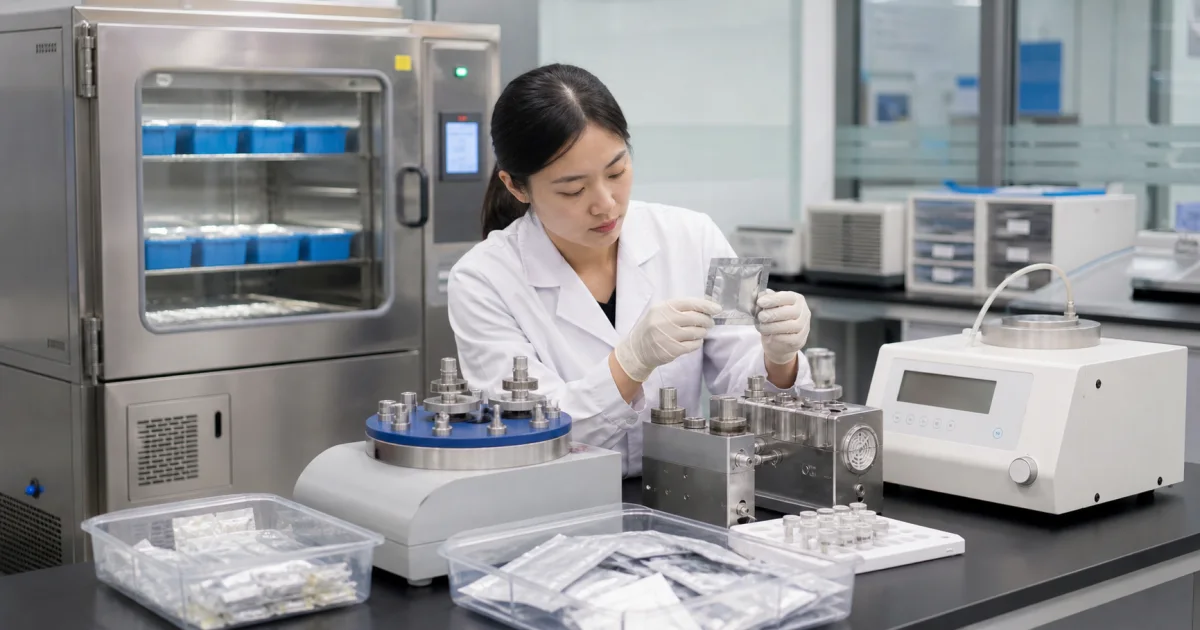
Caffeine ODF vs caffeine pouches is an important format decision for energy and wellness brands. Both can deliver a portable, water-free consumer experience, but they use different manufacturing processes, packaging systems and quality specifications.
Updated for 2026. This B2B comparison covers nicotine-free products only and is intended for brand owners, wholesalers and private-label buyers.
Quick Format Comparison
| Factor | Caffeine ODF | Caffeine pouch |
|---|---|---|
| Physical format | Thin orodispersible film strip | Filled nonwoven oral pouch |
| Primary pack | Individual high-barrier sachet | Round can with multiple pouches |
| Manufacturing | Mixing, casting, drying, slitting and sachet sealing | Powder blending, filling, sealing and can packing |
| Formula capacity | Limited by film area, thickness and mechanical performance | More fill volume for fibers and multi-ingredient blends |
| Main sensory challenge | Bitterness, film mouthfeel and disintegration | Bitterness, moisture, pouch softness and flavor release |
| Retail story | Modern single-dose strip | Familiar reusable-can format |
Formula Development Differences
Caffeine ODF requires the active, film former, plasticizer, sweetener and flavor to remain compatible through casting and drying. Increasing active load can affect viscosity, brittleness, tackiness and taste. The target must therefore be confirmed through pilot film, not calculated from raw-material concentration alone.
Caffeine pouches offer more physical fill volume. Fibers, humectants and flavor systems can be adjusted independently, but the manufacturer must control blend uniformity, pouch weight, seams and moisture. For either format, finished-unit caffeine testing is more useful than a raw-material certificate alone.
Packaging and Shelf-Life
ODF is normally packed one film per sachet because the thin strip is sensitive to moisture exchange and handling. The laminate, seal width and tear behavior become critical components of the product specification. Pouches are commonly packed together in a can, so can closure, liner, seal and repeated opening behavior matter.
| Packaging question | ODF buyer check | Pouch buyer check |
|---|---|---|
| Moisture control | Sachet water-vapor barrier | Can and seal moisture retention |
| Unit protection | Seal integrity and film sticking | Seam strength and powder leakage |
| Artwork space | Sachet plus retail carton | Can label, lid and optional carton |
| Lot coding | Sachet or carton coding | Can and case coding |
MOQ and Cost Drivers
ODF MOQ is often influenced by printed sachet laminate, production setup and analytical testing. Caffeine pouch MOQ is often influenced by blending and filling changeover, can decoration and label quantities. A stock sachet size or stock can can reduce packaging commitment, but the finished formula still requires an approved specification and suitable testing.
Quality Testing
- Caffeine ODF: film dimensions, thickness, weight variation, assay, content uniformity, disintegration, moisture and sachet integrity.
- Caffeine pouches: pouch dimensions, fill weight, assay, blend uniformity, pH, moisture or water activity, seam strength and can integrity.
- Both formats: microbiological quality, formula-specific contaminants, stability and label review.
Which Format Fits Your Brand?
ODF can suit a brand seeking individual unit presentation, sample packs and a visibly different delivery format. Caffeine pouches can suit brands prioritizing flavor range, flexible fill weight and familiar can-based merchandising. Some portfolios may use both, but each format should have a clear use case rather than duplicating the same product without differentiation.
OEM Sample Request
- State the target market and proposed product category.
- Define caffeine per unit and acceptable tolerance.
- Request at least two flavor-intensity levels.
- Compare commercial packaging, not only loose laboratory samples.
- Ask for finished-unit assay and stability evidence.
- Review warnings and claims before artwork approval.
Explore our Caffeine ODF, caffeine pouches and private-label ODF manufacturing guide.
Frequently Asked Questions
Is Caffeine ODF automatically faster than a caffeine pouch?
No. Disintegration or flavor onset does not by itself prove faster systemic absorption. Product-specific claims require appropriate evidence.
Which format has the lower MOQ?
It depends on formula, equipment setup and packaging. Printed sachets can control ODF MOQ, while custom cans can control pouch MOQ.
Can the same flavor be used in both formats?
A similar profile may be developed, but direct transfer is rarely exact because the film matrix and pouch fill release flavor differently.
Are both formats nicotine-free?
The products discussed here are nicotine-free. The approved ingredient list and finished specification should confirm the formula.