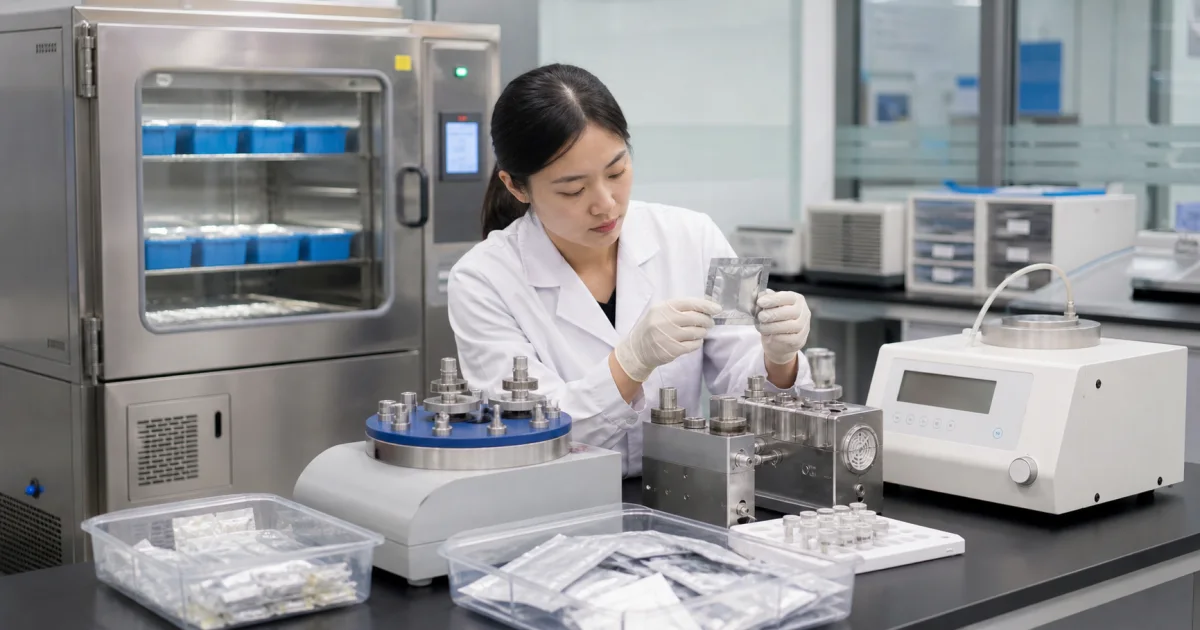
Melatonin ODF stability testing must evaluate the active ingredient, the polymer film and the sachet as one system. Light, oxygen, moisture and heat can affect assay, degradation products, color, flavor, flexibility, disintegration and package release. A film that looks acceptable after storage may still have changed chemically or mechanically.
This article is for OEM and private-label product teams. It does not provide sleep or medical-use advice.
Why melatonin ODF needs product-specific stability work
Orodispersible films have a high surface-area-to-mass ratio and can exchange moisture quickly when unprotected. The polymer matrix may contain plasticizers, flavors, sweeteners and acids that influence chemical stability. Melatonin is present at a relatively low amount in many concepts, making reliable assay and content uniformity important.
Packaging data for an empty laminate cannot replace stability data for the filled product. Seal quality, sachet size and residual headspace all affect real performance.
Stability risks and useful observations
| Stress factor | Possible effect | What to monitor |
|---|---|---|
| Light | Assay loss, degradants or color change | Photostability comparison and protective packaging |
| Oxygen | Ingredient or flavor oxidation | Assay, related substances, aroma and barrier integrity |
| Moisture gain | Tack, sticking, slow release or microbial risk | Moisture, water activity and sachet release |
| Moisture loss | Brittleness, curl and cracking | Mechanical tests and appearance |
| Heat | Faster chemical and physical change | Assay, degradants, disintegration and seal integrity |
Design a stability-indicating analytical method
The assay method should distinguish melatonin from relevant degradation products and formulation interference. Method suitability needs to cover extraction from the polymer matrix, because incomplete recovery can appear as potency loss. Filters, containers and sample hold time should not introduce bias.
Content uniformity should be evaluated separately from average assay. A batch can have the correct average but contain variable individual films if coating or cutting is inconsistent.
Evaluate light and oxygen protection
Development studies can compare protected and light-exposed samples to identify sensitivity and confirm whether the proposed laminate provides adequate protection. Clear development packs may be useful as controls but should not be assumed suitable for sale.
Oxygen exposure depends on laminate barrier, seal integrity and headspace. Aroma changes may provide an early signal, but sensory review cannot replace analytical testing. Nitrogen flushing or oxygen absorbers should only be introduced when their benefit, compatibility and process control are demonstrated.
Control moisture without making the film brittle
Residual moisture supports flexibility, but too much can cause tackiness or sachet sticking. Excessive drying can produce curl and cracks. The target range should be based on mechanical properties, disintegration, assay and packaging performance rather than a single convenient moisture result.
Samples should be protected during handling because thin films can change rapidly in ambient humidity. Maximum open-film time before sachet sealing should be defined.
Validate the sachet and seal
Barrier selection should consider water-vapor and oxygen transmission, light protection, sealant compatibility and opening experience. Seal contamination by film fragments can create leak paths. Vision inspection and seal-integrity tests should challenge missing, folded or misplaced units.
Stability programs should include commercial-size batches and final packaging. Real-time data establishes shelf life; justified accelerated conditions help identify likely failure modes and support development decisions.
OEM buyer checklist
- Use a stability-indicating assay and related-substances method.
- Verify extraction recovery from the final polymer matrix.
- Test assay, content uniformity, moisture and water activity.
- Track tensile properties, curl, sticking and disintegration.
- Evaluate light exposure and oxygen-barrier performance.
- Validate sachet seals after transport and temperature cycling.
- Set shelf life from product-specific real-time data.
Frequently asked questions
Can accelerated stability alone establish shelf life?
Accelerated studies are useful, but shelf-life decisions should follow the applicable regulatory framework and be supported by appropriate real-time data.
Does aluminum foil solve every stability problem?
No. Laminate construction, seal integrity, film formulation and manufacturing controls all contribute.
Why can a film pass assay but still fail stability?
It may become brittle, tacky, slow to disintegrate, difficult to remove from the sachet or unacceptable in flavor even if assay remains within limits.
See our private-label melatonin ODF checklist, ODF residual-moisture guide, ODF sachet packaging guide and ODF converting accuracy guide.
Compliance note: product classification, ingredient permissions, warnings and stability requirements vary by destination market.