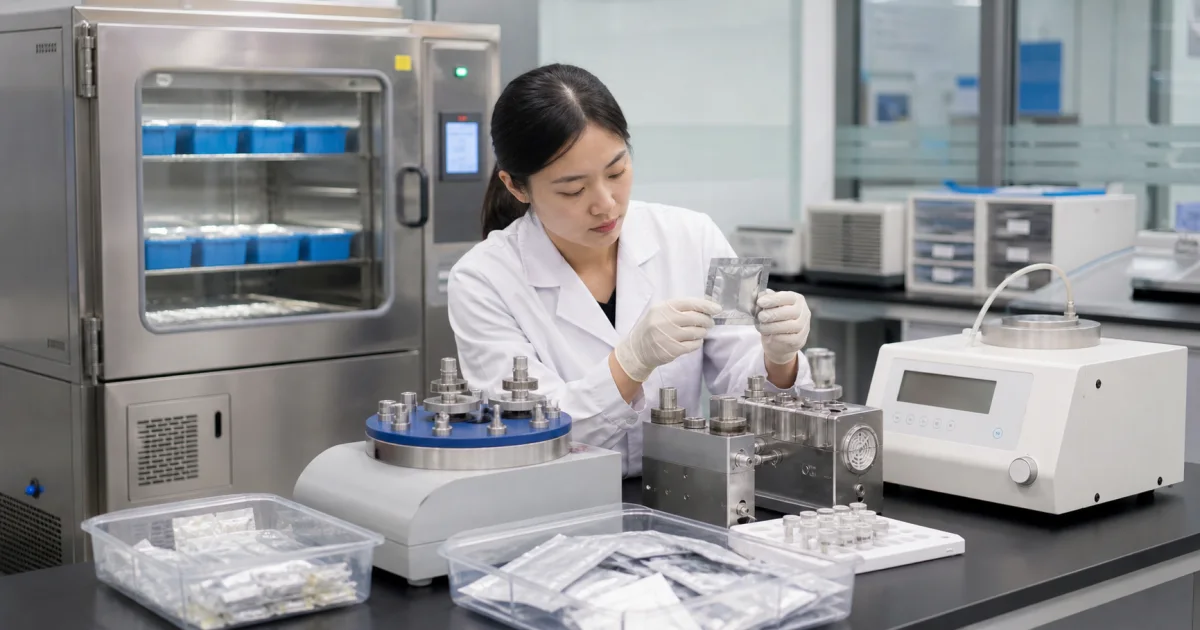
Oral pouch pilot batch scale-up is the controlled transfer of a laboratory formula into equipment and batch sizes that represent commercial manufacturing. The goal is not simply to make more material. Scale-up must show that mixing, powder transfer, filling, sealing, moisture control and packaging can consistently produce nicotine-free functional pouches that meet the approved specification.
This guide is intended for brand owners and OEM teams developing caffeine, guarana, nootropic or other nicotine-free oral pouches.
Why a laboratory formula changes during scale-up
Laboratory blends often use small containers, short transfer distances and manual filling. Commercial production introduces larger mixer geometry, longer discharge paths, hopper residence, machine vibration and faster sealing. These differences can change blend uniformity, particle segregation, flavor distribution and fill-weight variation.
Moisture and temperature may also drift. A blend that remains open for ten minutes in the laboratory could be exposed for much longer during production. Hygroscopic ingredients may absorb moisture, while volatile flavors may be lost during mixing or transfer.
Critical scale-up areas
| Process stage | Main scale-up risk | Useful evidence |
|---|---|---|
| Raw-material dispensing | Low-dose weighing or identity error | Verified weights and material traceability |
| Pre-blending | Uneven caffeine or active distribution | Defined dilution method and blend samples |
| Main mixing | Under-mixing, over-mixing or heat generation | Mixer load, speed, time and uniformity data |
| Transfer and hopper | Segregation, clumping or flavor loss | Discharge and hopper sampling |
| Pouch filling | Weight drift and powder in the seal | Time-based individual weight trend |
| Heat sealing | Weak seams or fabric damage | Seal window and leak testing |
| Can packing | Count, headspace or closure variation | Pack count, torque and integrity checks |
Freeze the formula before transferring the process
The pilot batch should use the approved ingredient grades, suppliers, particle-size ranges and pouch fabric. Substituting a different carrier or flavor grade during scale-up can make the trial difficult to interpret. Formula quantities should be expressed with clear tolerances and a documented manufacturing order.
Low-dose ingredients require a defined pre-blend strategy. The team should not assume that extending mixer time will correct poor initial distribution. Excessive mixing can increase dust, break particles or encourage segregation.
Translate mixing conditions, not only mixing time
A larger mixer does not reproduce a small mixer by using the same number of minutes. Fill level, geometry, speed and energy input affect movement. Pilot work should evaluate the shortest process that achieves repeatable uniformity without damaging the blend.
Samples should represent multiple mixer and discharge locations. Testing only one convenient sample can miss stratification. When practical, compare beginning, middle and end-of-discharge results.
Challenge filling and sealing at realistic speed
The filling line should run long enough to reveal hopper effects, weight drift and material buildup. Record individual pouch weights by time and lane. The average alone is insufficient because heavy and light units can cancel each other.
Heat-seal settings need to be challenged with the actual formula, maximum intended fill weight and commercial fabric. Inspect seams for powder inclusion, wrinkles, hard edges and leaks. Start-up and restart material should remain segregated until acceptable operation is confirmed.
What should a pilot-batch report contain?
- Formula, raw-material lots and approved specifications.
- Equipment identity, capacity and operating parameters.
- Actual mixing, transfer, filling and sealing times.
- In-process weight, moisture, pH and appearance results.
- Blend and finished-unit assay or content-uniformity data.
- Deviations, machine stops, rejected material and corrective actions.
- Samples retained for sensory and stability review.
- Recommended commercial control ranges and unresolved risks.
Use the pilot batch to define commercial readiness
A successful pilot batch should be reproducible, not merely acceptable once. Critical parameters and material attributes must be converted into operating ranges, in-process checks and release requirements. Any manual adjustment used during the trial should be documented and assessed for scalability.
Frequently asked questions
Is a pilot batch the same as a commercial validation batch?
Not always. A pilot batch supports process understanding and risk reduction; formal validation expectations depend on the product, quality system and applicable requirements.
Can flavor be adjusted during the pilot run?
Development adjustments may be possible, but they should be controlled and documented. A changed formula needs appropriate retesting.
How many pilot batches are required?
There is no universal number. Complexity, novelty, equipment differences and the consistency of results determine how much supporting work is appropriate.
Continue with our functional pouch manufacturing guide, powder flow and segregation guide, heat-seal validation guide or request an OEM scale-up discussion.