A lower caffeine result in a used pouch does not show how much reached a person's bloodstream. A useful recovery study accounts for the unused unit, the test liquid and the material still held by the nonwoven. Each fraction answers a different question for an oral pouch development team.
Editorial scope: technical development and supplier review. Published 16 November 2026. The study and control suggestions below are not reported results from this supplier.
Define the accounting boundary
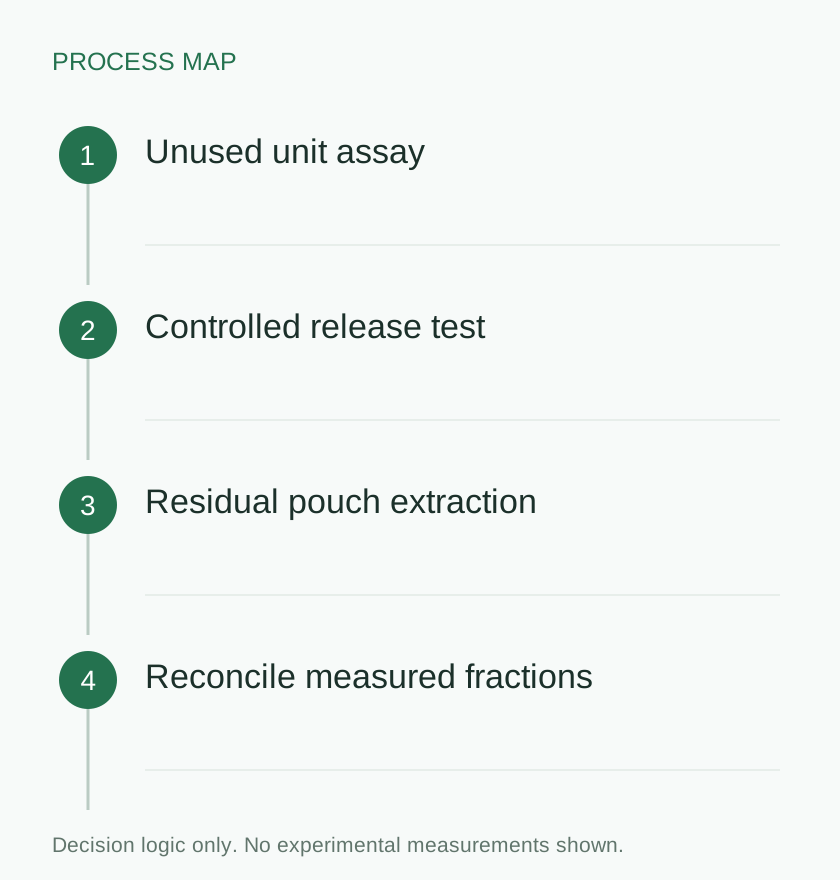
For a laboratory release experiment, establish the starting content from comparable unused units using a qualified extraction method. Collect the release medium, then extract the recovered pouch and any material left on the holder. Record rinses and sample withdrawals. Avoid weighing a saliva-wet pouch and calling the difference released active: absorbed water, dissolved carrier and nonwoven fibers confound that calculation.
Check recovery before interpreting disappearance
Include an empty nonwoven control, a medium blank and a matrix spike. If caffeine binds to the apparatus or remains inaccessible to extraction, an apparent shortfall can be a method problem. ICH Q2(R2) provides a fit-for-purpose validation framework, although a food or supplement pouch needs its own product-specific method and applicable regulatory assessment. Recovery, release and absorption are separate measurements.
Turn a mass balance into a development decision
In a hypothetical test, a 40 mg starting amount, 28 mg recovered in medium and 10 mg recovered from the pouch leave 2 mg unaccounted for. That is 95% analytical recovery across measured fractions, not 70% human bioavailability. Investigate the missing fraction and report uncertainty before comparing two formulas. Use the same holder, time points and extraction procedure for both candidates.
Development review checklist
- Identify the starting lot and the unused-unit sampling plan.
- Retain pouch, holder rinse and medium as separately identified fractions.
- Correct for sampled liquid and replacement medium.
- Report unrecovered material without assigning it to skin or oral uptake.
- Agree on acceptable analytical recovery before the comparison.
Buyer questions
Does the pouch get lighter as caffeine leaves?
Wet mass cannot isolate caffeine loss. Use a specific assay with separate recovery of carrier and test liquid.
Does removing a pouch end all exposure immediately?
A laboratory recovery result cannot answer what was already released or swallowed. Product instructions and exposure assessment need separate evidence.
Can the nonwoven retain active ingredient?
It may; evaluate extraction of the actual contact material rather than assuming all residual content sits in loose powder.
Is a release curve a bioavailability curve?
No. It describes transfer into the specified test medium. Human uptake needs an appropriate study of the finished product.
What should an OEM buyer request with a recovery percentage?
Ask for the mass-balance equation, fraction identities, raw results, blank corrections and the method recovery assessment.
References and scope
- FDA: ICH Q2(R2), Validation of Analytical Procedures
Fit-for-purpose analytical validation framework; pharmaceutical guidance used as technical background, not a certification for these products.
- FDA: Spilling the Beans, How Much Caffeine Is Too Much?
Total caffeine from all sources; 400 mg/day statement limited to most adults, not a target or universal safe limit.
Discuss the specification and evidence needed for your project. Send the intended use, destination market and the attribute you need to verify. Commercial capability and acceptance criteria require a project-specific agreement.