
Two laboratories can test the same pouch and produce different release curves because their artificial saliva is different. A medium name is not a method specification. For buyer comparisons, the recipe, preparation and operating conditions should travel with every result.
Editorial scope: technical development and supplier review. Published 16 November 2026. The study and control suggestions below are not reported results from this supplier.
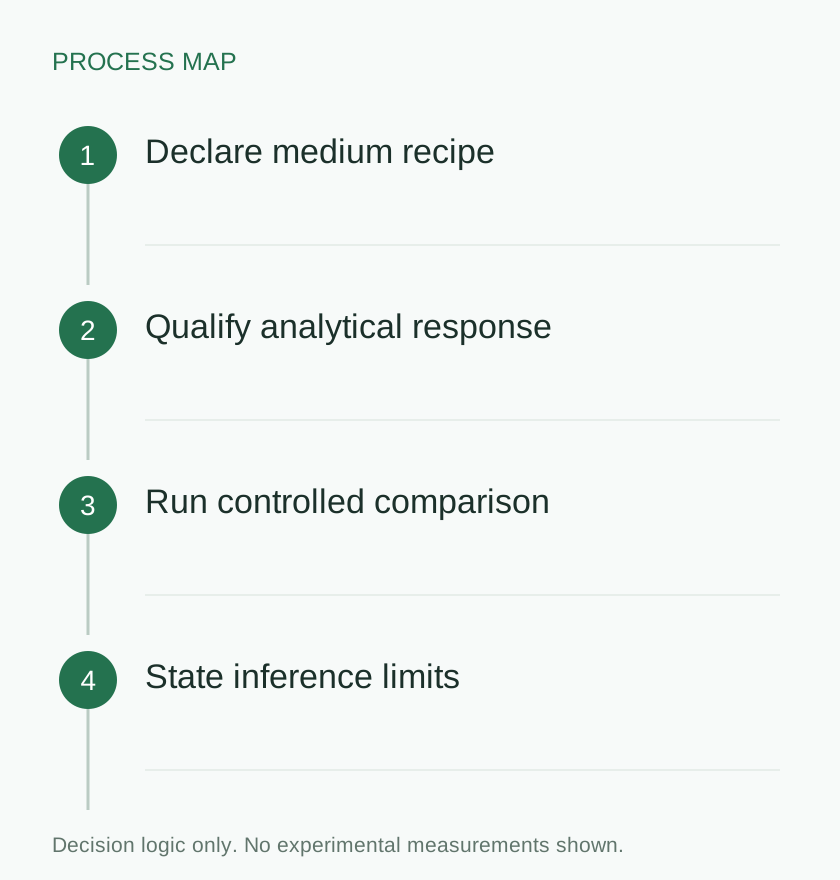
Specify composition and operating conditions
Record salts, buffer, pH, temperature, liquid volume and any enzymes or proteins. Document whether the medium is freshly prepared, filtered or reused. Saliva substitutes used for mouth comfort are not automatically suitable analytical release media. Fix the pouch orientation, agitation and wetting procedure as well; otherwise a changed curve may reflect a changed test environment.
Check that the medium permits measurement
A formulation ingredient can interfere with a UV or chromatographic result. Demonstrate selectivity in the complete medium and pouch matrix, and verify analyte stability during the experiment. Sampling filters and tubes can introduce loss. A suitable method distinguishes actual release from degradation, adsorption and sampling artifacts. The validation question is whether the reported quantity can be measured reliably under these conditions.
Use comparisons within a declared boundary
A simplified medium can be useful for screening packaging or formula changes when the method is consistent. It should not be described as a complete replica of a human mouth. In vivo saliva flow, swallowing and contact vary. If a supplier changes the medium recipe, require a bridge using the same retained samples before combining old and new results in a development trend.
Development review checklist
- Attach the full recipe and preparation instructions.
- State medium volume and whether sink conditions were evaluated.
- Record agitation, holder design and sample replacement.
- Check matrix selectivity, analyte stability and filter recovery.
- Label results as in vitro measurements, not human absorption.
Buyer questions
Can water replace artificial saliva in a release test?
It can define a different screening method. Results from water and a buffered saliva medium should not be treated as interchangeable.
Does physiological pH make a test clinically predictive?
No. Matching one variable leaves many biological and mechanical differences uncontrolled.
Why specify agitation if the pouch sits still?
Fluid movement affects the local concentration gradient and contact. It belongs in the reproducible method.
Can two suppliers be compared using their own methods?
Only with clear limitations. A common protocol or a method-bridging exercise gives a more interpretable comparison.
Should a medium contain enzymes?
That depends on the development question. Specify and justify them rather than assuming every artificial saliva recipe is equivalent.
References and scope
- FDA: ICH Q2(R2), Validation of Analytical Procedures
Fit-for-purpose analytical validation framework; pharmaceutical guidance used as technical background, not a certification for these products.
- FDA: Small Entity Compliance Guide, Dietary Supplement CGMP
Specifications and production records where dietary-supplement classification applies; not automatic classification of every oral pouch.
Discuss the specification and evidence needed for your project. Send the intended use, destination market and the attribute you need to verify. Commercial capability and acceptance criteria require a project-specific agreement.