Private label mushroom pouches need a clearer ingredient brief than “lion’s mane extract.” Ask the supplier to identify the species, whether the material is fruiting body or mycelium, its extraction process, and the method behind any beta-glucan figure. Then verify that the proposed material works in a finished oral pouch. A powder certificate alone does not establish pouch content, mouthfeel or shelf life.
Brand teams can compare mushroom pouch concepts with other nootropic pouches. These are procurement and quality questions, not claims that a pouch improves memory or treats a condition.
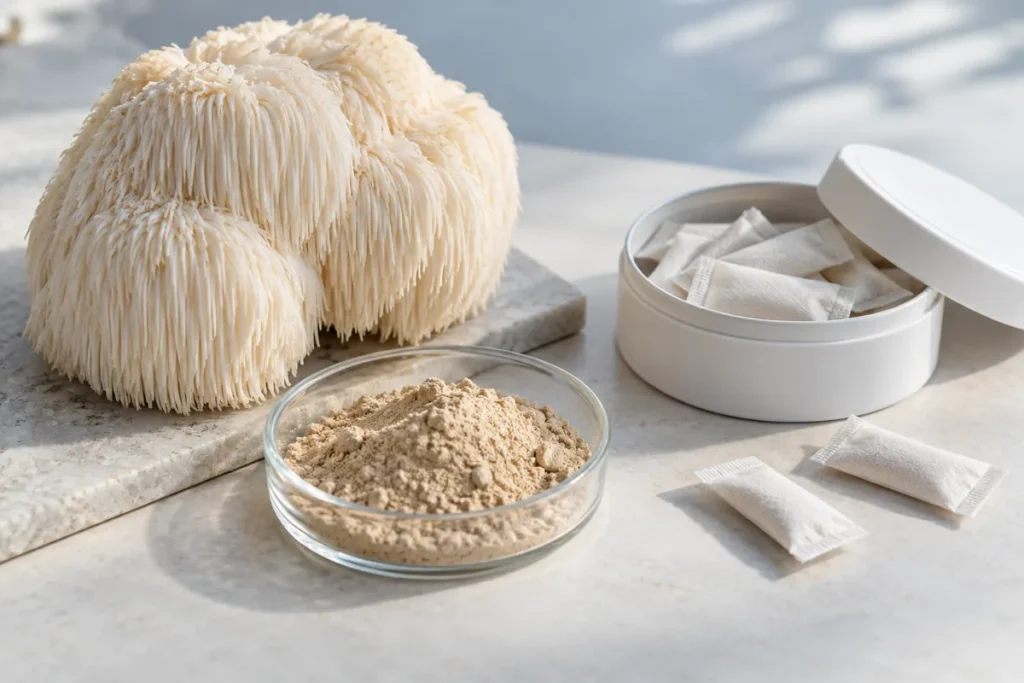
What should a lion’s mane ingredient specification name?
Write Hericium erinaceus on the specification and identify the supplied material as fruiting body, mycelium, or a stated blend. “Mushroom extract” alone does not tell a lab what to authenticate or a formulator what to expect. Record the substrate, drying and extraction steps, carrier ingredients, batch identifier and intended test method before approving a sample.
Identity is a separate question from strength
DNA barcoding can help establish fungal species in processed material, although extraction may leave too little usable DNA and species identity does not measure the concentration of a constituent. In a published study, researchers generated ITS barcodes for 33 representative fungal samples. That is a demonstration of the method, not a survey of the current pouch market. Ask an independent lab whether its identity method is suitable for the exact powder or extract being purchased.
| Buyer asks for | Why it matters | Evidence to retain |
|---|---|---|
| Species and source material | Fruiting body and mycelium are different inputs | Supplier specification plus suitable identity test |
| Extraction and carrier | Processing changes concentration and handling | Process description and complete ingredient declaration |
| Marker result | “Polysaccharides” does not identify beta-glucans | Named method, units, basis and batch result |
| Contaminant limits | Raw-material risk travels into the pouch | Relevant microbiology and contaminant reports |
How should buyers read a beta-glucan certificate?
Require the assay name, sample basis and results for total, alpha and beta glucans when beta-glucan content is part of the purchase specification. A broad “total polysaccharides” percentage is not an interchangeable beta-glucan result. Published mushroom analyses calculate beta-glucan by subtracting measured alpha-glucan from total glucan, so a certificate should show enough detail for that calculation to be understood.
Set the acceptance range with the supplier and testing laboratory after seeing pilot-lot variation; there is no universal percentage that makes every lion’s mane pouch effective. Check whether results are reported on a dry-weight basis, as-received ingredient basis, or per finished pouch. Those numbers answer different questions. If the powder is diluted with carriers during pouch manufacture, an ingredient-level percentage should never be presented as a finished-unit amount.
What changes when the extract goes into an oral pouch?
Powder identity and assay are only the start. A pouch also has to fill consistently, seal cleanly and remain acceptable after storage. Compare the extract with the proposed filler and flavor system in a pilot blend, then measure fill-weight spread and the selected marker in representative finished pouches. The sampling plan must address blend segregation rather than testing only one convenient pouch.
Screen the sensory and moisture trade-offs
Botanical powders can bring earthy flavor, particle grit and moisture sensitivity. Record mouthfeel and flavor in a blinded comparison against a control pouch, and monitor water activity and package condition over the intended storage period. Use the site’s water-activity meter guide and allergen-control checklist when drafting the release plan. Those articles address separate risks; neither substitutes for a finished-product stability study.
What belongs in a private label mushroom-pouch RFQ?
Send one controlled brief that ties the raw material to the finished unit. State the intended market and product classification, source material, full ingredient list, pouch size, proposed declaration per pouch, packaging, and required shelf-life evidence. Ask the manufacturer to identify which tests it performs internally, which are outsourced, and which results will appear on each lot’s release documents.
- Request a retained reference sample and the same lot code on the ingredient COA, pilot batch and finished pouches.
- Agree a method and sampling plan for identity, marker content, microbiology and relevant contaminants.
- Test sensory acceptance, fill uniformity and packaging before final artwork approval.
- Confirm the production minimum and the cost of changing the ingredient source or formula after pilot approval.
The site sample-request checklist gives a practical place to record these decisions.
Which claims should stay out of the first draft label?
Do not turn an ingredient assay into a promise of cognitive benefit. A measured beta-glucan amount documents composition; it does not demonstrate that a finished oral pouch improves focus, memory or a medical condition. Product classification and permitted claims depend on the destination market and the actual formulation, so have the importer review the artwork before printing cans.
For a product marketed as a US dietary supplement, FDA guidance distinguishes structure/function statements from disease claims and requires appropriate substantiation and labeling. That guidance should be applied to the real product category, not assumed to approve a particular mushroom-pouch claim. Keep the substantiation file with the approved wording and the lot-level records that support any quantitative ingredient declaration.
Sources and scope
- Raja et al., Food Chemistry: DNA barcoding of consumer-relevant mushrooms.
- McCleary and Draga, Journal of AOAC International: beta-glucan measurement in mushrooms and mycelial products.
- FDA: dietary supplement manufacturing and specification guidance.
- FDA: dietary supplement claims guide.
Editorial review: 24 October 2026. The cited laboratory approaches describe how to specify and assess material; they do not certify any Linkbiolabs ingredient, facility or finished pouch.
Frequently asked questions
Is a 30% polysaccharide claim the same as 30% beta-glucans?
No. Total polysaccharides and beta-glucans are different measurements. Request the named assay, sample basis and a beta-glucan result before comparing suppliers.
Does DNA testing prove a mushroom extract is potent?
No. A suitable DNA test can help confirm species identity, but it does not quantify beta-glucans or establish the strength of a finished pouch.
Can an ingredient COA replace finished-pouch testing?
No. The ingredient COA identifies the incoming lot. Finished-pouch testing is needed to assess unit content, uniformity and the risks introduced by blending and storage.
Can a lion’s mane pouch be advertised as treating memory problems?
A disease-treatment claim needs a separate regulatory and evidence review. An ingredient specification or assay result does not support that claim.