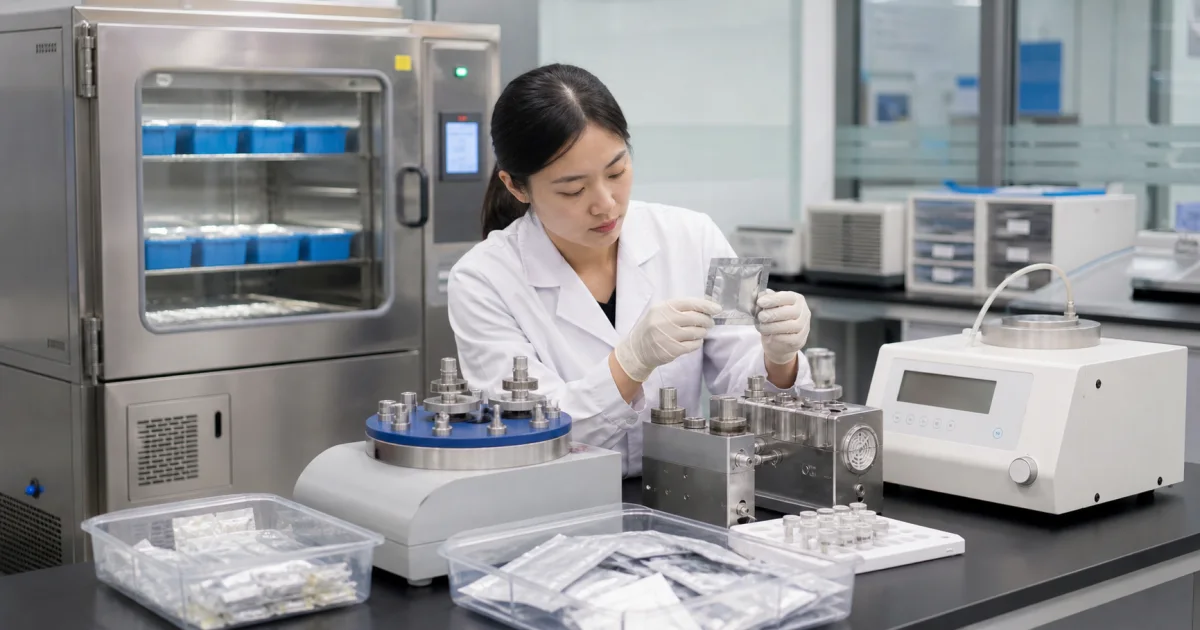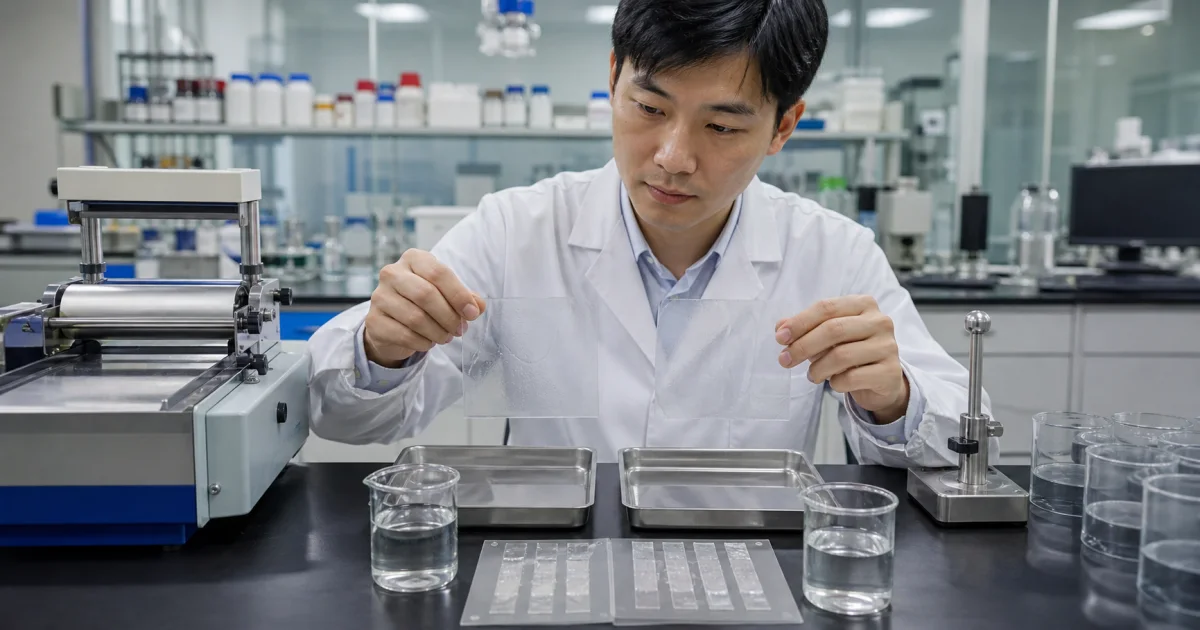
ODF residual moisture testing helps define the narrow range in which an oral film remains flexible enough to handle but dry enough to avoid blocking, sachet sticking and chemical instability. Moisture is not merely a final release number. It changes during drying, conditioning, slitting, sachet packing and storage, so the OEM needs a sampling plan that follows the entire process.
Residual moisture and water activity are different
Residual moisture describes the amount of water present in the film under a defined test method. Water activity describes how available that water is for chemical, physical or microbiological processes. Two films with similar moisture content can have different water activity because polymers, plasticizers, sugars and salts bind water differently.
| Measurement | Primary use | Important method details |
|---|---|---|
| Loss on drying | Routine moisture trend | Temperature, time and possible volatile loss |
| Karl Fischer | More selective water determination | Extraction efficiency and reagent suitability |
| Water activity | Available-water and stability assessment | Sample equilibration and temperature |
| Weight change | Moisture ingress/egress study | Humidity, exposure time and packaging state |
Where to sample moisture during manufacturing
Testing only the finished sachet can hide process variation. Useful sampling points include the start, middle and end of a coated roll; both web edges and center; post-conditioning film; slit reels; and units immediately before and after sachet sealing. This shows whether the dryer, room humidity or hold time creates gradients.
Samples must be protected from ambient air before testing. Thin films exchange moisture quickly. Open handling can change the result enough to confuse troubleshooting.
How moisture causes curl and brittleness
Overdrying can reduce film flexibility and increase cracking at folds or cut edges. Uneven drying can create internal stress and curl. When the film later absorbs humidity, dimensions and mechanical properties may shift again. A suitable conditioning step allows the film to approach a controlled equilibrium before conversion.
Moisture targets should be connected to tensile strength, elongation, folding endurance and disintegration—not selected as an isolated number.
Why ODF sticks inside the sachet
Sticking can result from high residual moisture, plasticizer migration, hygroscopic ingredients, heat exposure or insufficient barrier performance. Seal temperature and pressure can also transfer heat toward the film if sachet geometry is poor. The investigation should inspect both film and laminate surfaces rather than assuming the formulation is solely responsible.
Accelerated studies can reveal risk, but they do not replace real-time stability. Transport simulation is useful for markets with hot or humid distribution routes.
Set a moisture specification from product data
The acceptable range should be established during development using batches that meet mechanical, disintegration, assay, uniformity and packaging requirements. A single ideal result is not a robust specification. Pilot and commercial-scale data are needed to demonstrate process capability.
OEM buyer checklist
- Identify the moisture test method and sample preparation.
- Define in-process and finished-product sampling locations.
- Compare moisture with water activity and mechanical properties.
- Review room humidity and maximum open-film hold time.
- Validate sachet barrier and seal integrity.
- Include hot/humid transport conditions in the stability plan.
- Investigate trend movement before results exceed limits.
Frequently asked questions
Is lower residual moisture always better?
No. Excessive drying can make an ODF brittle, slow redispersion of some polymers or create curl and cutting problems.
Can a desiccant solve sachet sticking?
It may help in some secondary packages, but it cannot replace a suitable formulation, validated drying process and correctly selected primary sachet barrier.
How quickly can an unpackaged film absorb moisture?
The rate depends on film composition, thickness, temperature and humidity. OEM teams should determine a maximum handling time experimentally.
Related reading: ODF sachet barrier guide, ODF casting defect guide and ODF manufacturing overview.