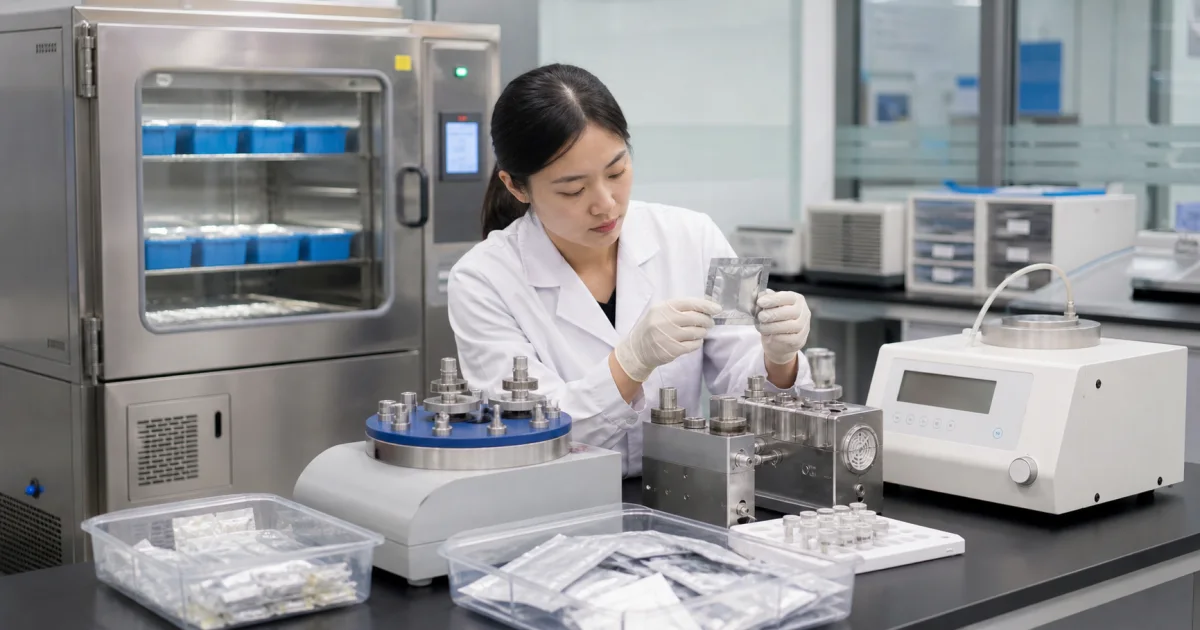
Guarana extract adulteration testing uses multiple lines of evidence to confirm botanical identity and detect substitution, undeclared added caffeine or inconsistent extraction. A caffeine assay alone is insufficient because a material can meet the target percentage without matching the expected guarana profile. Private-label pouch manufacturers should combine supplier qualification, identity tests, chromatographic data and finished-product verification.
Why caffeine percentage is not proof of identity
Standardized guarana extracts are often purchased to a defined caffeine range. However, caffeine can come from different botanical or non-botanical sources. Measuring only caffeine confirms the amount of that molecule, not the origin or complete composition of the extract.
Color and taste are also insufficient. Processing, carriers and storage can change appearance, while added materials can imitate bitterness or bulk density.
Testing approaches compared
| Approach | Main purpose | Important limitation |
|---|---|---|
| Botanical identity method | Confirms expected source characteristics | Highly processed extracts may lose morphology |
| Caffeine assay | Measures standardized active level | Does not prove caffeine origin |
| HPLC fingerprint | Compares multiple chromatographic features | Requires a qualified reference and method |
| Marker ratio review | Checks profile consistency | Natural and process variation must be understood |
| Moisture and ash | Detects some dilution or processing changes | Not specific enough when used alone |
| Supplier audit | Reviews sourcing and process controls | Does not replace incoming verification |
Build an HPLC fingerprint program
A fingerprint method compares the pattern of selected peaks, retention relationships and relative responses with qualified authentic material. The purpose is not to make every botanical lot identical; it is to distinguish acceptable natural variation from a materially different profile.
Reference lots should be well characterized and stored correctly. Method conditions, sample preparation and acceptance rules need documentation. A visual chromatogram comparison without defined criteria is difficult to defend.
Investigate marker ratios and carriers
Declared extraction ratio, standardized caffeine, carrier type and carrier percentage should be part of the purchase specification. Unexpected marker ratios may indicate different extraction, degradation or added caffeine, but conclusions should consider natural variation and analytical uncertainty.
Carriers such as maltodextrin can influence color, density and assay on an as-is basis. Undeclared or changing carriers can affect blending, flavor and finished-pouch dose calculations.
Qualify the supplier, not only the sample
Supplier approval should review botanical sourcing, extraction location, change control, traceability, contamination controls and certificate reliability. Initial qualification may include enhanced testing across several lots. Ongoing verification can then be adjusted based on performance and risk.
A perfect pre-sale sample is not enough if later commercial lots come from a different process or subcontractor. Agreements should require notification before changing source, carrier, standardization method or manufacturing site.
Connect raw material to finished pouches
The OEM must calculate caffeine contribution using the actual assay and verify the finished product. Blend uniformity and finished-unit testing confirm that authentic material is distributed consistently. Sensory and color comparison across lots helps manage botanical variability.
Buyer checklist
- Specify botanical identity, plant part and extract information.
- Define standardized caffeine range and reporting basis.
- Approve carrier identity and allowable percentage.
- Use a qualified identity or fingerprint method.
- Review several lots before routine approval.
- Require supplier change notification and traceability.
- Verify finished-pouch caffeine assay and uniformity.
Frequently asked questions
Can HPLC prove geographic origin?
Not necessarily. A fingerprint supports identity and consistency within a method, but geographic-origin claims need appropriate evidence.
Does darker powder indicate higher purity?
No. Color depends on raw material and processing and should not replace analytical testing.
Is synthetic caffeine in guarana extract always adulteration?
Any added source must be accurately disclosed and permitted. Whether it constitutes adulteration depends on specification, labeling and applicable requirements.
Continue with our standardized guarana verification guide, guarana batch-variation guide and private-label guarana sourcing guide.