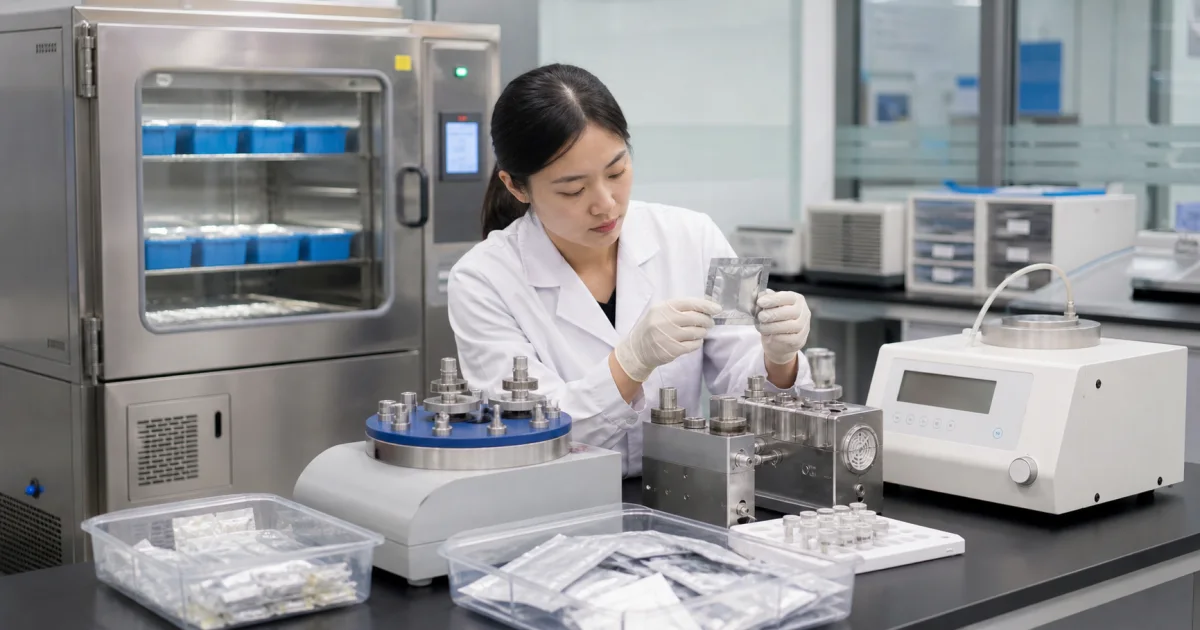
Oral pouch water activity meter verification ensures that an aw result reflects the sample rather than instrument drift, poor temperature control or inconsistent preparation. Water activity supports formulation and shelf-life decisions because it describes available water, while moisture content describes the total amount of water. The two values are related but are not interchangeable.
Why water activity matters in functional oral pouches
Water activity can influence texture, ingredient mobility, flavor release, caking and microbial risk assessment. A formulation with the same moisture content can show a different aw when salts, sweeteners, humectants or botanical solids change. Therefore, an OEM should establish product-specific relationships rather than copying one limit across every formula.
An aw result should support, not replace, a complete stability program that also tracks assay, sensory quality, package integrity and appearance.
Sources of testing variation
| Variable | Possible bias | Control |
|---|---|---|
| Instrument verification | Systematic high or low readings | Certified standards bracketing the sample range |
| Sample temperature | Slow equilibration or unstable result | Condition samples and instrument consistently |
| Sample amount | Poor representation or chamber contamination | Defined cup fill and exposed surface |
| Open-can exposure | Moisture gain or loss before testing | Prepare quickly in controlled conditions |
| Pouch location | Top-to-bottom can variation may be missed | Use a justified sampling plan |
| Flavor carryover | Sensor contamination or slow recovery | Cleaning and blank checks |
Verify the meter with suitable standards
Use traceable verification standards that cover or bracket the normal sample range. The laboratory should define acceptance criteria, frequency and action for an out-of-tolerance check. One standard near a single point may not reveal performance across the working range.
Verification should be performed after instrument relocation, sensor maintenance or an unusual result, as well as at the routine frequency. Records should include standard lot, expected value at the measurement temperature, observed result and disposition.
Standardize sample preparation
Define whether the laboratory tests intact pouches, opened pouch contents or a composite. That choice changes exposed surface and equilibration behavior. The method should specify the number of pouches, cup type, sample depth, handling time and endpoint rule.
Sample cups must remain clean and undamaged. Loose powder on the chamber rim can contaminate the sensor or prevent correct closure. Strong flavors may require additional cleaning and a blank verification before the next product.
Build a representative sampling plan
Development work should compare samples across mixer position, filling time and can position to understand variability. Routine release sampling can then focus on a justified plan. Replicate results help distinguish real batch variation from analytical repeatability.
During stability testing, measure units from unopened commercial packages. Repeatedly opening one can changes its humidity environment and may not represent consumer-ready shelf life.
Use trends instead of one isolated number
Plot aw with moisture, sensory observations and assay throughout real-time and accelerated storage. A gradual rise may indicate packaging moisture ingress; a fall may indicate drying or poor closure. Stable aw does not automatically prove adequate shelf life if flavor or active potency changes.
OEM buyer checklist
- Define why aw is measured and how it supports the specification.
- Use traceable standards that bracket the product range.
- Control sample temperature, cup fill and equilibration endpoint.
- Specify intact, opened or composite sample preparation.
- Evaluate sampling variation across the batch and can.
- Trend aw with moisture, assay, sensory and package integrity.
- Document action when a standard or duplicate fails acceptance.
Frequently asked questions
Is water activity the same as moisture percentage?
No. Water activity measures available water, while moisture testing measures total water under a defined method.
Can one aw limit apply to every pouch flavor?
Not automatically. Ingredients and humectants change the relationship between aw, texture and stability.
Should pouches be removed from the fabric before testing?
The method must define this choice and demonstrate that it produces repeatable, meaningful results for the intended purpose.
Related reading: oral pouch shelf-life validation, can seal testing, flavor migration control and low-drip pouch formulation.