
Editorial guide · OralPouches.com · Updated 22 October 2026
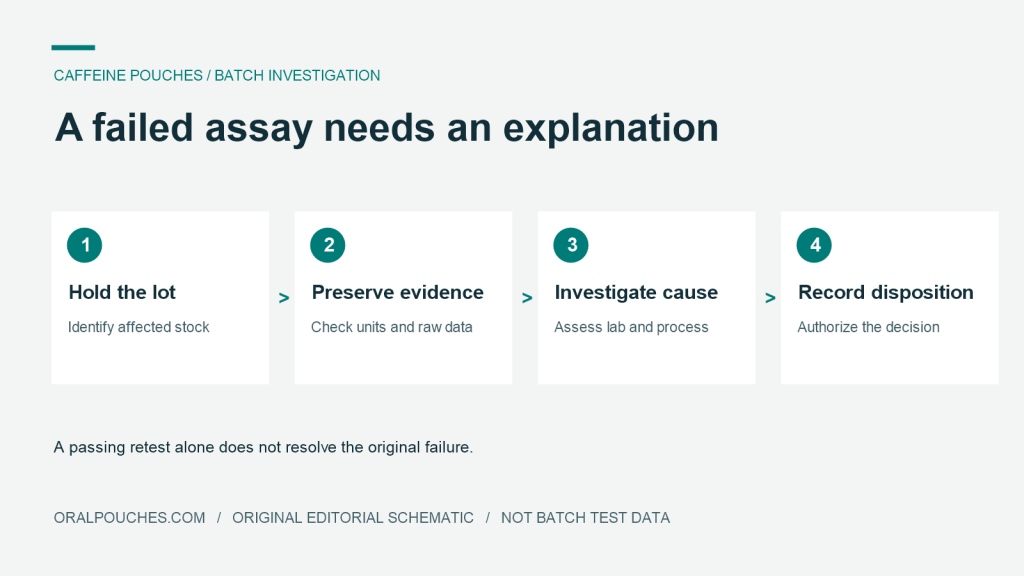
A caffeine pouch assay outside the agreed specification should trigger a documented investigation and a batch hold. A second passing result, on its own, does not explain the first failure. Before authorizing shipment, the brand owner needs to know whether the discrepancy comes from the sample, the analytical method, a calculation, or the manufactured batch.
This guide addresses nicotine-free caffeine and guarana pouches supplied under an OEM or private-label agreement. It provides a purchasing and quality-review framework, not a product-specific release specification. The examples are illustrative; they are not LINKBIOLABS batch data.
What counts as OOS, and how is it different from OOT?
An out-of-specification (OOS) result falls outside a pre-established acceptance criterion. An out-of-trend (OOT) result may still meet that criterion but differs unexpectedly from previous batches or stability observations. Neither term tells you the root cause. A failed caffeine assay is also different from an underweight pouch: the first concerns measured analyte content; the second concerns total fill mass.
The FDA’s May 2022 OOS guidance concerns pharmaceutical laboratory testing. Its distinction between laboratory investigation and broader production investigation is a useful reference, but it does not automatically make pharmaceutical requirements applicable to every functional pouch. Confirm product classification and destination-market obligations separately.
Write the acceptance rule before testing
- Identify the measured substance: total caffeine, rather than guarana extract mass.
- Define the reporting basis: milligrams per pouch, milligrams per gram, or percentage of a stated target.
- Specify whether the result represents individual units or a composite sample.
- Record the method version, sampling plan, acceptance range and agreed decision rule, including how measurement uncertainty is handled.
For the documents that establish these requirements, see our COA, product specification and laboratory report comparison.
First review: can the numbers be compared?
Check unit conversion and sample basis
Consider a hypothetical report of 80 mg/g caffeine in a pouch containing 0.50 g of fill. The calculated content is 40 mg per pouch: 80 × 0.50 = 40. Comparing the number 80 directly with a 40 mg-per-pouch target would create a false discrepancy. This calculation is an arithmetic illustration, not a recommended caffeine amount or an acceptance limit.
Ask whether the laboratory used actual fill mass, nominal mass or the mass of the entire pouch including its wrapper. Check whether results are reported as received or on a dry basis. A change in moisture can alter a concentration expressed per gram without establishing an equivalent change in caffeine per unit.
Separate total caffeine from botanical input
For a guarana formula, the amount of extract added is not the measured amount of caffeine delivered. Request the raw-material assay basis and the finished-product result. Where more than one ingredient contributes caffeine, the finished-pouch assessment must consider the combined contribution rather than checking only the synthetic caffeine addition.
Preserve the evidence before commissioning more tests
Send a written hold notice identifying affected batch numbers, shipment status and the person responsible for disposition. Retain the original report and request its supporting records through the supplier’s quality contact. Preserve the sample identity and custody history so that subsequent results can be linked to the same material.
- Laboratory package: method reference, sample preparation record, raw chromatograms, integration history, calculation sheet and system-suitability assessment.
- Sample package: collection location, collection time, quantity, container condition and storage history.
- Manufacturing package: ingredient reconciliation, blend identification, filling sequence, relevant deviations and any rework history.
- Commercial package: approved specification revision, purchase-order requirements and notification responsibilities.
These are suggested contract-review items. Access arrangements and confidentiality should be settled with the supplier and laboratory in advance. Our third-party laboratory selection guide covers scope and chain-of-custody questions before testing begins.
Retesting needs a question, not just another sample
FDA’s pharmaceutical guidance cautions against using averaging to conceal variability between an initial OOS result and later results. For pouch procurement, agree a written investigation protocol with the responsible quality team: what hypothesis is being examined, which material will be tested, how many determinations are justified and how all results will be evaluated.
Use findings to direct the investigation
- Confirmed calculation error: obtain a controlled report correction with the original result and reason retained in the audit trail.
- Suspected extraction or matrix issue: ask the laboratory to evaluate method suitability for the actual flavored pouch matrix.
- Results varying by fill sequence: investigate possible blend segregation or process variation using a justified sampling design.
- No demonstrated explanation: retain the unresolved result in the decision record; do not describe the lot as cleared solely because a later sample passes.
A composite assay can obscure unit-to-unit variability. If the concern is inconsistent individual pouches, explain that concern explicitly rather than requesting another pooled average. The investigation should also identify whether related lots need review.
What the final disposition record should contain
Ask for a concise conclusion that links evidence to the proposed action. It should identify the affected lot, original failure, investigated hypotheses, confirmed or unresolved causes, all relevant results, and the authorized disposition. Include corrective and preventive actions where justified, with an owner and an effectiveness check. An investigation closure date is not itself evidence that the problem has been corrected.
Before ordering a replacement batch, confirm what changed and which evidence will demonstrate that the change worked. For OEM discussions, provide the intended market, approved claim wording, analytical basis and sampling expectations alongside the commercial brief.
Frequently asked questions
Does a passing retest cancel the original failed result?
No. The investigation must explain how the original result was assessed and why the final decision is justified. Passing later tests alone do not establish that the first result was invalid.
Can a supplier change the specification after a failure?
A proposed specification change needs a documented scientific and regulatory basis and formal approval. Changing a limit simply to accommodate a failed lot is not a credible resolution.
Is an OOS result proof that every pouch in the batch is defective?
No. It is a signal requiring investigation. The sampling design and root-cause evidence determine what can be concluded about the batch and related lots.
Should every functional pouch follow pharmaceutical OOS rules?
No. The cited FDA document has a pharmaceutical scope. Applicable obligations depend on classification and market; the workflow here is an editorial procurement recommendation.
Source and editorial scope
Primary reference: FDA, Investigating Out-of-Specification Test Results for Pharmaceutical Production, May 2022. Reviewed 22 October 2026. The purchasing checklist and numerical example are original editorial material; no independent laboratory study or product certification is claimed.