
Editorial guide · OralPouches.com · Updated 22 October 2026
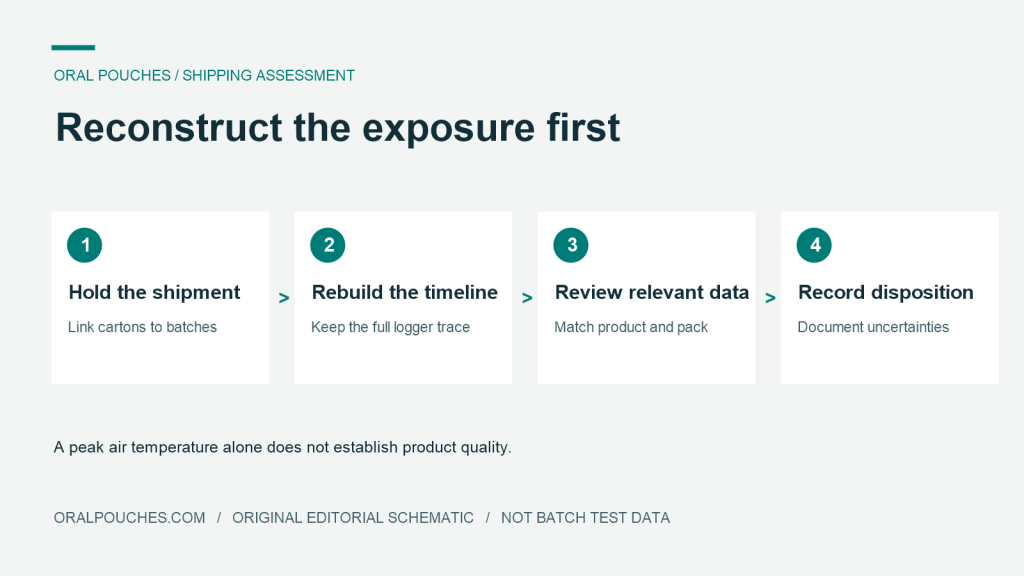
When an oral pouch shipment arrives after a temperature excursion, place the affected stock on hold and reconstruct the exposure before accepting or rejecting it. A container’s peak temperature alone cannot establish finished-product quality. The decision needs the duration, packaging configuration, condition of the goods and relevant evidence for that formulation.
This guide focuses on nicotine-free functional pouches shipped in retail cans and distribution cartons. It complements shelf-life testing by addressing a specific logistics event. It does not establish a universal shipping temperature or extend a manufacturer’s expiry date.
What is a temperature excursion?
An excursion is exposure outside the approved storage or transport conditions for the product. If the supplier has never defined those conditions, a logger alarm does not supply the missing product specification. Request the approved limits, their supporting evidence and the agreed procedure for handling deviations before the first shipment.
Distinguish the measurements
- Ambient temperature: air conditions at the logger location.
- Product temperature: temperature of the product or a justified representative measurement.
- Relative humidity: moisture conditions in the measured air, which do not directly measure water inside a sealed can.
- Package condition: physical evidence such as seal damage, leakage, distortion or wet cartons.
A logger beside a container door and one inside a central carton may describe different exposures. Record placement rather than assuming that a single trace represents every pallet.
Build a shipment evidence file
Request the raw logger record
Obtain the original export with timestamps, time zone, sampling interval, logger identity and calibration or verification status. Keep the alarm settings and any missing-data periods. A screenshot of the maximum temperature is insufficient for reconstructing the event.
As an illustrative calculation, a logger set to ten-minute intervals produces six readings per hour. Twelve consecutive readings above a limit suggest a sustained event, but the exact crossing times remain bounded by the sampling interval. Report the method used to calculate duration; do not present that estimate as continuous measurement.
Connect the trace to the physical goods
- Match container, pallet and carton references to finished-product batch numbers.
- Record departure, transshipment, customs hold and receipt times in a common time zone.
- Photograph the logger position and the condition of representative cartons and cans.
- Identify exposed quantities and segregate stock pending assessment.
- Record whether any quantity has already been distributed so that downstream action can be considered.
Use the same lot references as your batch traceability and retain-sample records. Good traceability limits uncertainty about which goods require review.
Which stability evidence is relevant?
The most useful evidence concerns the same formulation, pouch material, can, liner, closure and seal system. A study on a different flavor or packaging structure needs a documented justification before it is used to assess the shipment. Ask how old the shipped stock was at the time of the excursion: newly made and near-expiry stock do not necessarily have the same remaining quality margin.
ICH Q1A(R2), a pharmaceutical stability guideline, identifies accelerated data as potentially useful for assessing short excursions outside labeled storage conditions. Its general-case accelerated condition is 40 ± 2°C and 75 ± 5% relative humidity. These values are a pharmaceutical study reference, not a blanket transport permission for oral pouches.
Do not convert a chamber study into a shipping guarantee
A constant-temperature chamber exposure and a variable shipping event may differ in package stress, moisture transfer and the endpoints measured. A passing caffeine assay after transport does not establish acceptable odor, seam condition or mouthfeel. Conversely, a brief ambient peak does not by itself demonstrate that the pouch contents reached the same temperature.
For the distinction between study design and shelf-life claims, see our accelerated stability testing guide. For this shipment, request a written bridge between the available study and the actual exposure rather than relying on a generic statement that the product is stable.
Select checks that address the likely failure
The quality team should select endpoints from the approved specification and the event assessment. The following are proposed investigation questions, not universal acceptance criteria or a mandatory test panel.
- Seal or closure concern: examine the relevant seal and closure performance using the approved package assessment method.
- Moisture-related concern: compare appropriate moisture or water-activity measurements with established limits and comparable retained stock.
- Flavor concern: use a controlled assessment against an approved reference; avoid unsupported descriptions such as “unchanged” based only on opening one can.
- Active-content concern: request suitable finished-product testing, with additional degradation-related assessment where scientifically justified.
- Contamination concern: have the responsible quality specialist determine the necessary evaluation; normal appearance does not establish microbiological acceptability.
Sample location matters. A convenient carton from the center of a pallet may not address visible damage at its outer edge. Document a sampling rationale that reflects the observed distribution of exposure and damage.
Document disposition and improve the next shipment
The assessment should state the evidence reviewed, uncertainties, affected quantity and authorized decision. Depending on the findings, that decision may be release under existing conditions, continued hold for further assessment or rejection. Any proposed change to shelf life or storage instructions requires its own justification and authorization.
Close the logistics loop as well. Compare the event with the planned route, seasonal conditions, customs dwell time and carrier arrangements. Possible improvements include better logger placement, a different shipment window or revised packaging qualification. Choose measures based on the identified cause; adding insulation without evaluation does not establish that future shipments will comply.
Frequently asked questions
Can pouches be released if the cans look normal?
Appearance is only one observation. Release needs a documented assessment against the product’s requirements and relevant exposure evidence.
Does 40°C stability testing mean shipping at 40°C is acceptable?
No. A stability study supports specific conclusions under its tested conditions. Transport acceptance requires a justified connection to the actual product, package and exposure.
What if there is no temperature logger?
Use available carrier records and route information, clearly identifying their limits. They cannot recreate the exact product exposure. The responsible quality team must account for the additional uncertainty.
Can a mean temperature replace the full time record?
A simple average can hide short peaks and long excursions. Preserve the full record; any model used to interpret it needs a justified relationship to the product and failure mechanism.
Source and editorial scope
Primary reference: ICH Q1A(R2), Stability Testing of New Drug Substances and Products, 6 February 2003. Reviewed 22 October 2026. Pharmaceutical guidance is cited for a defined scientific principle, not as a declaration of pouch classification. The shipment checklist and logger example are original editorial recommendations, not measured customer-shipment data.