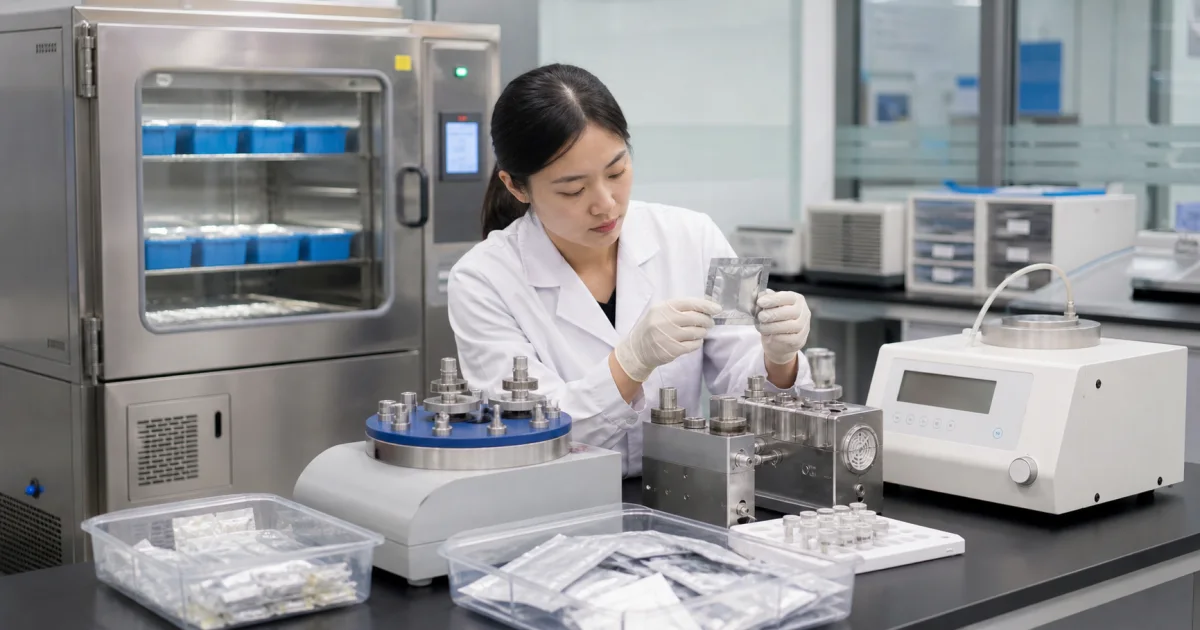
Caffeine pouch taste masking is the process of reducing caffeine bitterness without making a nicotine-free oral pouch excessively sweet, acidic or strongly flavored. The most reliable OEM approach does not depend on one powerful sweetener. It combines caffeine grade, particle distribution, pH, flavor architecture, cooling or warming sensation, pouch moisture and timed release. For brand owners, the objective should be a balanced profile that remains acceptable throughout the intended use period—not only during the first minute.
This technical guide concerns nicotine-free functional oral pouches. It is intended for brand development, sourcing and quality teams and does not make medical or performance claims.
Why is caffeine difficult to mask in an oral pouch?
Caffeine has a distinct bitter taste that can become more noticeable as saliva enters the pouch and dissolves the formula. Unlike a beverage, an oral pouch remains in one location and releases ingredients over time. A flavor that seems balanced in a dry powder or short bench test may develop a harsh aftertaste after ten or twenty minutes.
The challenge increases when a brand requests high caffeine loading, a small pouch format or a low-sweetness positioning. More active material must be distributed through less carrier, while the formulator has less sweetness and flavor intensity available to cover the bitter note.
Caffeine pouch taste-masking tools compared
| Formulation tool | Main contribution | Common risk when overused |
|---|---|---|
| Sweetener blend | Reduces perceived bitterness and rounds flavor | Lingering sweetness or metallic aftertaste |
| Acid and buffer system | Adds brightness and changes flavor balance | Sharpness, instability or oral discomfort |
| Cooling ingredients | Redirects attention and supports mint profiles | Burning sensation or flavor fatigue |
| Encapsulated flavor | Controls onset and extends selected notes | Higher cost and processing complexity |
| Carrier and particle design | Changes wetting and release rate | Segregation or inconsistent unit performance |
| Moisture and humectants | Influence softness and early flavor release | Drip, tackiness or shorter stability |
Start with caffeine grade and dose uniformity
Taste development begins with a verified raw-material specification. Different particle sizes, bulk densities and impurity profiles can change blending behavior and sensory quality. The OEM should confirm identity, assay and relevant purity requirements, then maintain an approved supplier and change-control process.
Masking must never hide poor dose control. Low-dose ingredients require a documented pre-blending or geometric dilution procedure. Finished-pouch assay and content-uniformity testing should demonstrate that improvements in flavor have not introduced segregation or unit-to-unit variation.
Use a layered sweetener system instead of one dominant note
Sweeteners differ in onset, intensity and aftertaste. A rapid sweetener can improve the first impression, while another component may support the middle and later stages. Xylitol or erythritol can contribute bulk and mouthfeel, while high-intensity sweeteners may reduce the amount required. The appropriate combination depends on the target market, ingredient permissions and desired label positioning.
Increasing sweetness without a timed sensory test often creates a new problem: the pouch tastes acceptable initially but leaves a long artificial finish. Prototype evaluation should score bitterness, sweetness and aftertaste separately at several time points.
Balance flavor, acidity and oral sensation
Mint, coffee, citrus and selected herbal profiles can complement caffeine, but each creates a different formulation challenge. Mint may use cooling to soften bitterness; coffee can integrate roasted notes; citrus may use acidity for brightness. Acids and buffers also influence pH, ingredient stability and oral sensation, so they should not be adjusted solely by taste.
A good flavor brief defines more than a name. It should specify onset, peak intensity, intended duration, sweetness ceiling, cooling level and unacceptable after-notes. This gives the flavor house and pouch manufacturer measurable development direction.
Control release through the pouch system
Pouch fabric, powder particle size, moisture, humectants and fill density determine how quickly saliva enters and dissolved materials leave. A rapid-release formula may produce an early bitter spike. A very slow system may feel weak at first and then become unbalanced later. The complete pouch—not only the loose blend—must therefore be evaluated.
Packaging studies are also necessary. Flavor oils can migrate into the can or liner, and moisture changes can alter both release and aftertaste. Pilot samples should be tested after conditioning, accelerated exposure and realistic transport simulation.
OEM sample approval checklist
- Confirm caffeine identity, assay, supplier and particle-size specification.
- Define the target caffeine amount and finished-unit uniformity criteria.
- Score bitterness, sweetness, cooling and aftertaste at timed intervals.
- Evaluate the final pouch fabric, fill weight, moisture and packaging.
- Compare fresh and aged samples rather than approving only day-one flavor.
- Review ingredient permissions and marketing claims for every destination market.
Frequently asked questions
Can more flavor completely remove caffeine bitterness?
Usually not. Excess flavor may cover the first impression but create harshness or an artificial finish. A layered formulation and controlled release are more reliable.
Does natural flavor automatically produce a cleaner taste?
No. Sensory quality depends on the complete flavor system, dosage, carrier, stability and interaction with the pouch matrix—not only the natural or artificial classification.
Should a brand approve the strongest-tasting prototype?
Not necessarily. Approval should reflect the intended consumer profile, use duration, storage stability and repeatability of commercial production.
For related sourcing decisions, review our white-label caffeine pouch manufacturing checklist, third-party caffeine HPLC testing guide and low-drip caffeine pouch formulation guide. Brand owners can also request an OEM formulation discussion.
Compliance note: ingredient permissions, caffeine limits, warning statements and product classification vary by market. Verify current local requirements before manufacture, import or sale.