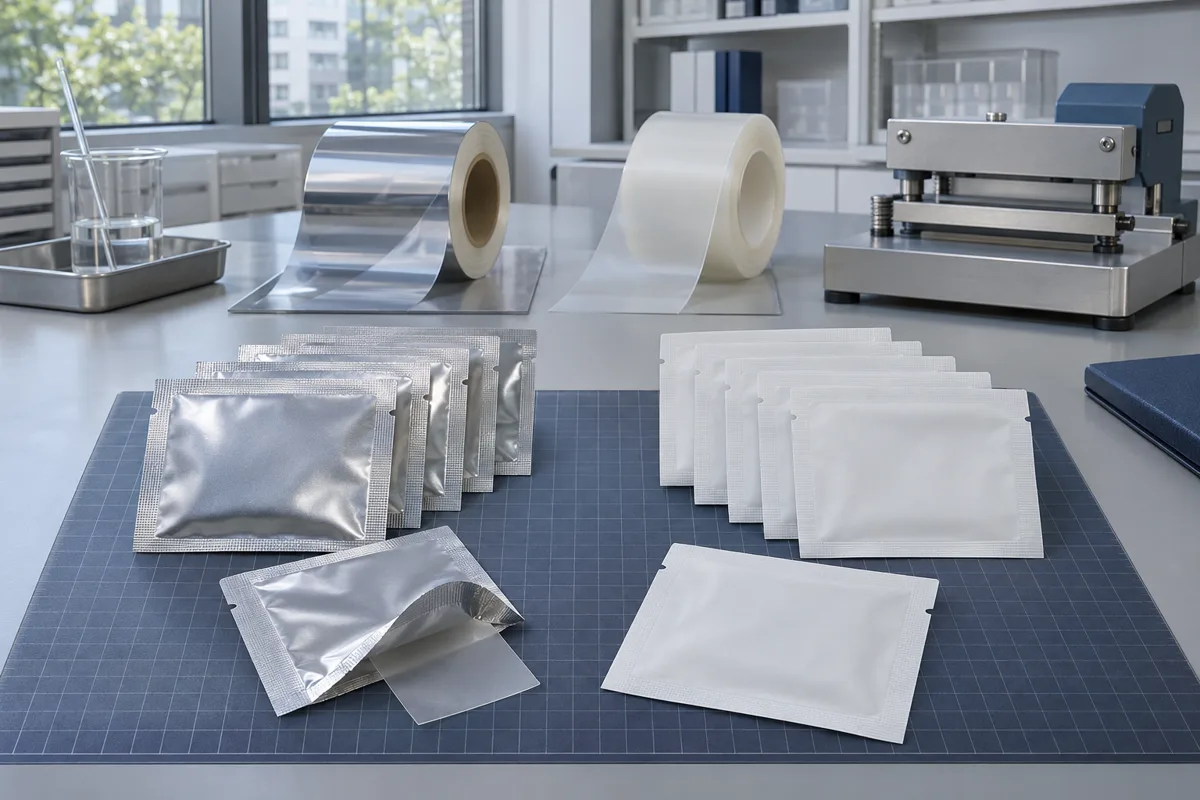

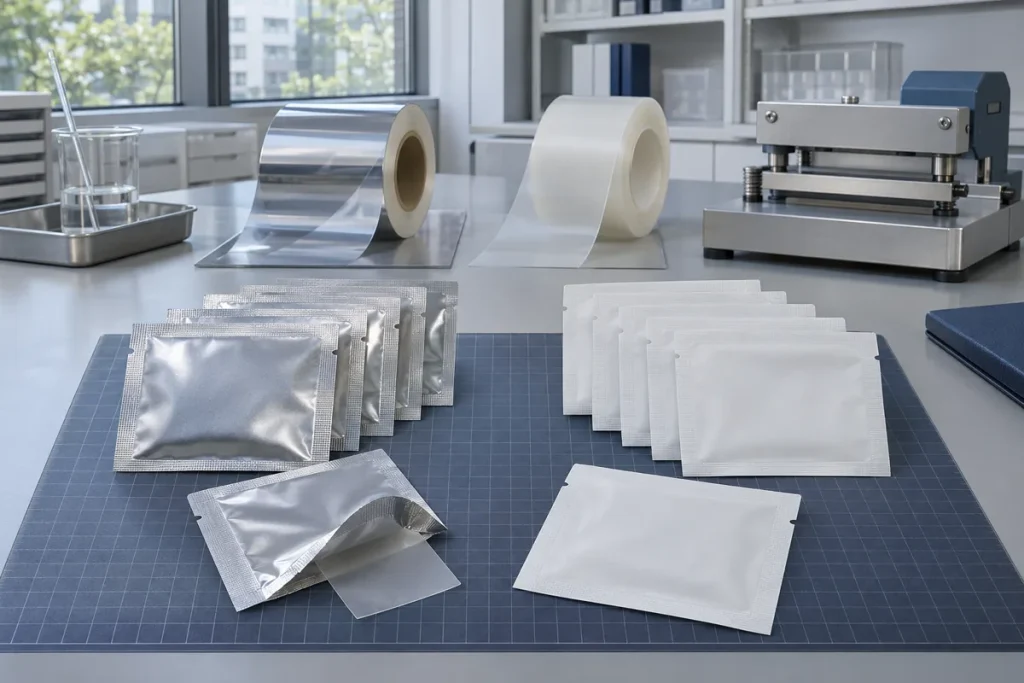
Choose an ODF sachet by testing the finished film inside the finished pack, then assess the packaging’s end-of-life route. A mono-material structure may simplify a recyclability design brief, while a foil laminate may offer a stronger starting barrier. Neither label predicts actual shelf life, seal reliability or collection in a destination market. For private-label orodispersible film, request comparable data from both candidate packs before approving artwork.
This article adds a material-choice layer to the site’s ODF sachet barrier guide and ODF packaging guide. It does not certify either pictured material as recyclable.
Which data belong in the material comparison?
Ask suppliers for the exact film structure and measured water-vapor transmission rate (WVTR) and oxygen transmission rate (OTR). Record the method, temperature, relative humidity, units and which surface faced the test atmosphere. A single “high barrier” description is not enough to compare two constructions. Include sealant compatibility, opening force, print surface and possible interaction with flavor components.
| Buyer question | Mono-material candidate | Foil-laminate candidate |
|---|---|---|
| Barrier | Ask for measured WVTR/OTR at stated conditions | Ask for the same metrics and conditions |
| Seal | Validate the proposed heat-seal window | Validate the proposed heat-seal window |
| End of life | Check actual market collection and sorting | Document construction and actual route |
| Film outcome | Run final-pack stability | Run final-pack stability |
ASTM F1249 addresses WVTR measurement for flexible barriers; ASTM D3985 addresses oxygen transmission through film. The reported number is meaningful only with the conditions and material identity.
Why test sealed sachets rather than film rolls alone?
The roll does not reveal pack-line failures. Heat-seal contamination, pinholes, folds and transport abrasion can defeat a good film barrier. Qualify the sealing window, test seal integrity and peel behavior, then package the actual ODF formulation. Stability checks should include film assay, curling, sticking, disintegration behavior and visual changes under intended conditions.
Minimum prototype record
- Material structure, supplier lot, gauge and test-condition-specific WVTR/OTR.
- Sealer settings, seal-strength or integrity method and reject criteria.
- Film formula and batch, pack date, storage conditions and test time points.
- Product-specific shelf-life criteria and deviation decisions.
The sachet peel-strength guide and film stability guide cover two different failure modes. Include both when the product brief needs an easy-open pack with robust protection.
What does the EU packaging rule change?
EU Regulation 2025/40, the Packaging and Packaging Waste Regulation, applies from 12 August 2026. Its recyclability framework develops toward design-for-recycling performance grades from 2030, with further criteria and implementation details. The European Commission’s 2026 guidance clarifies parts of the rule. A purchasing team should not call a sachet “EU compliant” merely because a supplier markets it as mono-material.
Ask for composition, material weights, coatings and adhesives, food-contact evidence where relevant, and the manufacturer’s market-specific recyclability assessment. Regulatory classification of the ODF itself and packaging obligations both need local review. Recheck the rule before a 2027 or later launch because delegated acts can affect the design assessment.
How should a buyer make the final choice?
Run the same film batch in both sachets and compare the cost of a usable shelf life, not just price per thousand empty pouches. Include rejected seals, line speed, storage results, transport damage and documented end-of-life claims. If a mono-material candidate fails the required stability window, revise the structure or the product brief rather than promising recyclability at the expense of product integrity.
Request a written comparison matrix from the OEM and material converter. It should identify the winner by stated acceptance criteria and preserve the losing candidate’s data for future reformulation or a different target market.
Sources and scope
- ASTM F1249: water-vapor transmission method.
- ASTM D3985: oxygen transmission method.
- EU Regulation 2025/40.
- European Commission 2026 PPWR guidance.
Editorial review: 16 November 2026. Material suitability and legal claims require actual test reports and destination-market review.
Frequently asked questions
Is a mono-material ODF sachet automatically recyclable?
No. Structure, coatings, inks, sorting and local collection determine the result. Request market-specific evidence rather than relying on the material name.
Does foil laminate always give the longest ODF shelf life?
No. Film chemistry, seal defects, storage conditions and the complete pack can dominate performance. Compare finished sachets in stability studies.
Which barrier numbers should an OEM buyer request?
Request water-vapor and oxygen-transmission results with test method, temperature, relative humidity, units and the exact material construction.
Can a film-roll barrier report replace sealed-sachet testing?
No. The roll report does not assess heat-seal defects, pinholes created during packing or transport damage.