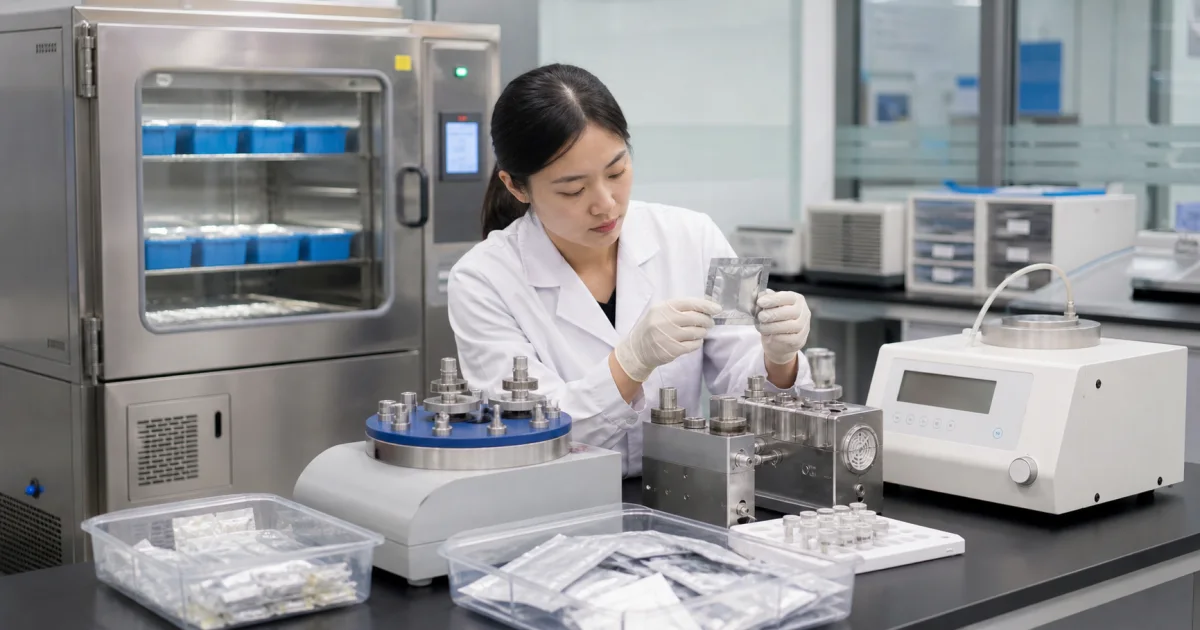
ODF sachet peel strength testing measures the force needed to separate a sealed package under defined conditions. The target must balance two requirements: the sachet should remain sealed through storage and transport, yet open predictably without tearing unpredictably or damaging the orodispersible film. A strong seal is not automatically a good seal if users cannot open it cleanly.
Why peel strength matters for ODF packaging
Orodispersible films are thin, moisture-sensitive and often packed individually. A channel or weak seal can allow moisture ingress, causing tackiness, curl or slow release. Excessive sealing can fuse layers too strongly, distort the sachet or create an opening force that varies widely.
Peel strength is only one part of package integrity. Barrier transmission, seal continuity, film placement and notch design also influence performance.
Key variables in an ODF peel test
| Variable | Why it matters | What must be controlled |
|---|---|---|
| Specimen width | Changes measured force | Cut dimensions and orientation |
| Peel angle | Changes stress at the seal interface | Fixture geometry and setup |
| Test speed | Can alter peak and average force | Validated instrument setting |
| Conditioning | Temperature and humidity affect laminate | Time and environmental conditions |
| Seal position | Edges may not be uniform | Multiple locations around the sachet |
| Failure mode | Explains how the seal separates | Adhesive, cohesive, tearing or delamination record |
Measure more than the maximum force
A single peak can result from a notch, wrinkle or local bond. Average force across the seal often gives a better picture of opening behavior. The force curve can reveal sudden spikes, intermittent bonding or an easy start followed by difficult peeling.
Failure mode should be documented. Clean separation at the intended interface differs from film tearing or laminate delamination, even if the numerical force is similar.
Validate the heat-sealing window
Seal temperature, pressure, dwell time and line speed interact with laminate construction. The OEM should challenge combinations near expected operating limits to establish a repeatable window. Actual jaw temperature and pressure need traceability.
ODF fragments, powder or flavor residue in the seal area can create channels. Vision inspection should detect misplaced, folded, doubled or missing films, and known-defect challenges should confirm the reject mechanism.
Combine peel testing with leak and barrier checks
An acceptable peel result does not prove the sachet is leak-free. Visual inspection, dye or other validated integrity methods can identify channels. Water-vapor and oxygen barrier performance should be evaluated using the final laminate and seal design.
Stability data should connect package integrity with residual moisture, film flexibility, disintegration, assay and sachet release. This shows whether small packaging changes matter to the product.
Test easy-open features after transport
Tear notches, laser scores and peelable sealants must survive carton packing, vibration, compression and temperature cycling. A notch that starts opening during transport is unacceptable; one that cannot be located or used consistently also creates a poor experience.
Testing should include different laminate lots, sealing lanes and time points. Samples from the beginning and end of the packaging run can reveal warm-up or buildup effects.
OEM packaging checklist
- Define specimen width, peel angle, speed and conditioning method.
- Set both numerical limits and acceptable failure modes.
- Sample multiple sachet edges, lanes and production times.
- Validate seal temperature, pressure, dwell time and speed.
- Challenge vision inspection and reject controls.
- Combine peel results with package-integrity testing.
- Repeat opening tests after stability and transport simulation.
- Confirm that the ODF does not enter or adhere to the seal zone.
Frequently asked questions
Does higher peel strength mean better protection?
Not necessarily. Protection depends on continuous sealing and barrier performance, while excessive force may make opening difficult or damage the laminate.
Can one sachet represent an entire packaging batch?
No. Seal performance can vary by lane, time, material lot and machine condition, so a defined sampling plan is required.
Is peel strength the same as burst strength?
No. Peel testing measures controlled layer separation, while burst or pressure methods evaluate package response to internal stress.
Continue with our ODF sachet packaging guide, ODF residual-moisture guide, ODF converting accuracy guide and melatonin ODF stability guide.